Event 1
Dalgliesh is assigned to investigate Nathan Oliver’s death
Dalgliesh’s assignment begins with an urgent summons to [New Scotland Yard](entity:organization-recall-organization-new-scotland-yar-966f1c616572) on Saturday, 23 October, and an immediate sense that the meeting concerns a death beyond the reach of routine administration. As a permanent ADC to the Commissioner, he had accumulated duties difficult even for colleagues to define; this summons, however, carried the unmistakable presaging of murder. The distinction mattered: accidental death might be manageable, suicide would be embarrassing, and murder could have consequences far beyond the island.
## The Assignment and Its Stakes
The meeting, in Assistant Commissioner [Geoffrey Harkness](entity:character-recall-character-geoffrey-harkness-86862940f81f)’s office, brought Dalgliesh together with [Alexander Conistone](entity:character-recall-character-alexander-conistone-cde393feca31) and Colin Reeves of [MI5](entity:organization-recall-organization-mi5-b8951c864c54). Conistone explained that the Prime Minister hoped to hold a top-secret international meeting on [Combe Island](entity:location-recall-location-combe-island-fad9a3251d49) in early January. No date had been fixed, and the identities of the expected participants and purpose of the gathering remained undisclosed to Dalgliesh. The island had nevertheless been selected as the likely venue, and the security rating, if the meeting proceeded, would be exceptionally high. The investigation therefore began under a dual pressure: establish what had happened to Oliver and determine whether the case would imperil a politically sensitive event.
Conistone asked Dalgliesh to take the case before Dalgliesh had been adequately briefed. Dalgliesh insisted that he needed more than the identity of the dead man, the place of death, and its apparent manner. When Geoffrey Harkness pushed a map across the table, he located Combe Island off Cornwall, about twelve miles from the mainland near [Pentworthy](entity:location-recall-location-pentworthy-9026651adaf8). The remote setting was not incidental; it made the investigation dependent on what could be learned on the island and heightened the significance of the security concerns surrounding it.
## Building the Investigation
Geoffrey Harkness urged Dalgliesh to take as few people as possible, describing a small team as preferable to an invasion. Dalgliesh proposed bringing Inspector [Kate Miskin](entity:character-recall-character-kate-miskin-bc49acd8ef06) and Sergeant [Benton-Smith](entity:character-recall-character-benton-smith-0cc25803bfb5), while noting that he was still awaiting a replacement for [Piers Tarrant](entity:character-recall-character-piers-tarrant-52794364a558). He judged that the team could initially manage without a crime-scene officer or official photographer, but that a confirmed murder would require reinforcements or a handover to the local force. He also wanted a pathologist and initially intended to contact Kynaston; Harkness instead said that Professor [Edith Glenister](entity:character-recall-character-edith-glenister-29889e6d3cc2) would be used.
The limits of the original briefing made Dalgliesh’s insistence on further information consequential. He had been given the dead man’s identity and the reported circumstances, but not enough to assess the island or the case. The assignment was thus not simply to investigate a death: it required him to assemble a workable inquiry while the island’s remoteness, security arrangements, and compressed timetable constrained decisions about personnel and support.
## Time of Death and the Staged Hanging
Professor Edith Glenister’s examination began to distinguish the apparent manner of death from the actual cause. She placed the time of death between 7:30 and 9:00 in the morning, probably nearer the earlier time. The ligature mark and bruising initially raised the question of hanging versus manual strangulation, but the finger-shaped bruises on the left side of Oliver’s neck pointed to an assailant’s grip. Glenister concluded that he had been strangled and hanged afterward; the rope’s patterned surface was consistent with a climbing rope.
A later autopsy report made the conclusion firmer. Oliver had died of asphyxiation caused by manual strangulation, with considerable internal damage and a fracture of the thyroid cartilage indicating force applied locally to his neck. A bruise at the back of his neck showed that his head had been driven against something hard. Glenister rejected the possibility that Oliver had inflicted the injury himself to make a suicide appear to be murder. The rope, moreover, had been wiped along its entire length, an attempt to remove evidence that made the hanging look less like a straightforward death and more like a deliberate staging.
## Witnesses and Physical Evidence
Dr. [Raimund Speidel](entity:character-recall-character-raimund-speidel-976a55c3f9a3) supplied a precise time marker. He said he had arranged to meet Oliver in the lighthouse at eight o’clock and arrived six minutes after the hour, having walked there by the under-cliff path. He could not enter because the door was locked. Speidel also said that he had not known Oliver personally and could not speak to his state of mind. His account placed a planned meeting at the lighthouse close to Glenister’s estimated time of death, without itself explaining what had happened inside.
The appointment’s arrangements also involved a note delivered by [Millie Tranter](entity:character-recall-character-millie-tranter-76ef6a950909). When asked about its urgency, she maintained that the meeting was not until eight that morning; the exchange prompted her startled recognition that the timing mattered. The note and Speidel’s account therefore formed part of the developing chronology, while leaving the central question of who had reached Oliver unresolved.
The inquiry later recovered additional material during a search: beneath the butter in a tub were two foil-wrapped packages, one containing a vial of blood labeled with Oliver’s name and date, the other a tissue-wrapped hair sample. Kate Miskin and Benton-Smith photographed the items, packaged them as exhibits, and signed the label. The assignment that began with an incomplete account of a death had thus opened into a broader evidentiary investigation, connecting the lighthouse’s apparent hanging to a murder inquiry and uncovering concealed samples whose significance required further examination.
Event 2
Kate Miskin and Piers Tarrant begin an affair

[Kate Miskin and Piers Tarrant begin an affair](entity:event-recall-event-kate-miskin-and-piers-t-d1d640280590) after years of mutual attraction held in check by professional rivalry and Kate’s determination not to risk her career. The change is decisive not because the scene promises a settled future, but because intimacy briefly reaches a part of Kate that work, disappointment, and self-protection have hardened. In the morning, a suspected murder summons her away from that new private happiness and back into the precise routines of her job.
## Before the Invitation
For Kate, the flat where the affair begins represents more than a place to sleep. Long planned and prudently mortgaged, it is her home, refuge, and security, made solid in bricks and mortar. She has never invited a colleague there. Her first and only lover, Alan Scully, left for America; although he wanted her to go with him, she refused, partly from fear of commitment and chiefly because her job came first. That history makes the new invitation a crossing of boundaries she has guarded for years.
Piers’s call arrives unexpectedly at Kate’s office early on Monday. He asks her to dinner on Friday. Since leaving [Adam Dalgliesh](entity:character-recall-character-adam-dalgliesh-461a7125784e)’s Special Investigation Squad for the anti-terrorist branch, Piers and Kate have not spoken. They had worked together for years, respected one another, and shared a half-acknowledged rivalry that Adam Dalgliesh had made use of. Their disagreements could be passionate without becoming acrimonious. Kate has found Piers one of the most sexually attractive men she has worked with, but attraction alone has never overcome her practical objection: an affair between close colleagues could jeopardize their competence, and one of them would have to leave the Squad. Her job had helped free her from Ellison Fairweather Buildings; she would not casually endanger what she had achieved.
## From Dinner to the Flat
At dinner, conversation becomes desultory over the puddings. Piers remarks that he dislikes coffee soon after fish; Kate says that she needs to sober up after the wine, though she knows she has not drunk enough to lose control. When they consider going to a flat, Piers accepts Kate’s suggestion that they go to hers. He briefly stops at his own place on the way, while Kate remains in the car; twenty minutes later they enter her sitting room together.
The flat looks different to Kate with Piers there. Its modern furniture, absence of mementoes, and lack of visible family history make it seem as impersonal as a carefully arranged show flat. Piers does not pause to inspect it: he goes straight to the windows and out onto the balcony. From inside, Kate watches him against the black, heaving Thames, its surface scored with silver, with the illuminated buildings on the opposite bank beyond him. She stays in rather than joining him. Later, she grinds coffee beans, prepares two mugs, and heats milk from the refrigerator. Seated together on the sofa, they finish their coffee; Piers leans forward and kisses her gently but firmly. Kate recognizes that the evening has been moving toward this moment from the first instant in the restaurant.
## Intimacy and Its Effect
Piers says that he would like to shower. Kate laughs at his matter-of-factness and directs him to the bathroom. The intimacy that follows surprises her not through any display of expertise but through its ease. She had expected an experienced lover; she had not expected their lovemaking to feel so uncomplicated and unstressed. They lie down with laughter as well as desire. Afterwards, in her double bed, she hears his breathing and feels his warmth, and his presence seems natural rather than intrusive.
That ease matters against the strain Kate has carried into the encounter. Her self-mistrust and defensiveness have accumulated alongside resentment and a sense of betrayal after the Macpherson Report. Piers is more cynical and politically sophisticated than she is, and he has shown little patience with her distress. Adam Dalgliesh, by contrast, has tactfully, sometimes without words, persuaded her not to resign. Kate remains valued and competent, and likes her work, but her original dedication and naïve enthusiasm have slowly drained away. She has become wary of emotional involvement and of what life can do. The night with Piers does not erase those injuries; it makes her aware of an almost forgotten joy and of a hard core of defensiveness beginning to soften.
## The Morning Call
The morning after, Kate stretches in bed beneath the pale-blue sky, hearing the kettle, a cupboard door, and china clinking in the kitchen. Piers is making coffee. Alone for the first time since they came to the flat together, she reviews the previous twenty-four hours with amazement rather than regret. The quiet domestic sounds give the new intimacy a brief, ordinary shape: he is not only the colleague she desired, but someone moving through her home.
That interval ends when the telephone rings. Kate answers, says that it is a case, and explains that the team has a suspected murder on an island off the Cornish coast. The assignment requires a helicopter; she must leave her car and meet Adam Dalgliesh’s team at Battersea Heliport. She is already moving, thinking through what must be done and in what order, and notes that her murder kit is in the office so Adam Dalgliesh can have it put in the car. The shift from shared bed and coffee to logistics is immediate. The scene establishes the affair as a genuine opening in Kate’s guarded private life while leaving its future unsettled: what it shows clearly is both her renewed capacity for joy and the force of the professional duty that continues to organize her choices.
Event 3
Mark Yelland receives Monica’s letter ending their marriage
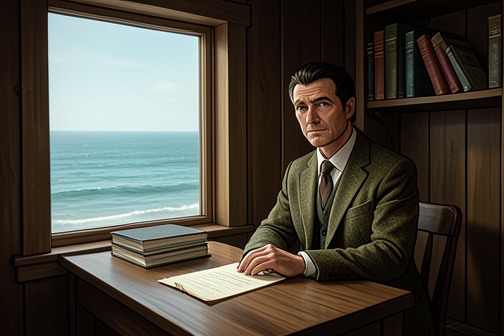
[Mark Yelland receives Monica’s letter ending their marriage](entity:event-recall-event-mark-yelland-receives-m-68d92ea67b4f) while staying in an isolated cottage on [Combe Island](entity:location-recall-location-combe-island-fad9a3251d49). The decision she describes is not a sudden departure: she has arranged a home, a school, and a move for their children, and Mark has learned of the plan only after it is already in motion. His response shifts from surprise and regret to a cold anger that breaks the restorative solitude he had sought on the island and prompts him to seek out [Nathan Oliver](entity:character-recall-character-nathan-oliver-b08f2093009a).
## The letter and the decision
Mark has arrived on the island for a two-week stay, bringing only necessary belongings and a carefully chosen supply of books and CDs. On his previous visits he had spoken to no one for the full fortnight. Food was left according to his written instructions, and he had declined the formal evening meal at [Combe House](entity:location-recall-location-combe-house-dd6545e484e5). The isolation, which he had initially wondered whether he could endure, had instead proved satisfying and healing; after returning to the traumas of his professional life, he had felt changed in ways he could not explain.
His arrangements make room for emergencies at work without requiring his own immediate return. [Home Office](entity:organization-recall-organization-home-office-3de7115d68d1) regulations require a Licence Holder or deputy Licence Holder to be in the laboratory or on call. Mark has left an experienced deputy in charge, expecting that the deputy can manage the inevitable crises during his absence and would contact him at Murrelet Cottage only in an extreme emergency. The professional system he has arranged to leave behind contrasts with the family life Monica says she can no longer accept.
While unpacking his books, Mark finds Monica’s letter placed between the two top volumes. She explains that she could not bring herself to tell him in person or give him the letter before he left; she expects him to read it in peace, without having to pretend to care more than he does. She plans to be gone by the time he returns from Combe Island, moving with Sophie and Henry to her mother’s home. There is room there, the children like the old nursery and garden, and a local school is prepared to take them at short notice. Monica says she has decided to end the marriage and regards the move as a sensible step before the children start secondary education. She expects to contact him about formal separation or divorce after settling in, but asks him not to reply.
## Mark’s response
On first reading, Mark is surprised by how calmly he takes Monica’s decision—and by the fact that he had not known she was planning it. He recognizes that the arrangements must have been under way for some time: Monica and her mother had acted together, a school had been found, and the children had been prepared for the move without his noticing. He wonders whether his mother-in-law helped compose the letter, whose practical coherence seems to him more characteristic of her than of Monica. His imagined picture of the two women working together on a draft is explicitly a fantasy, not a certainty about how the letter was written.
His strongest regret is not for the marriage itself but for the loss of Sophie and Henry. He feels no powerful resentment toward Monica, though he wishes she had chosen another moment and allowed him to enjoy his holiday without this added worry. That measured response does not last. A cold anger gradually takes hold, and Mark knows with increasing force that it is directed at Nathan Oliver. The letter thus exposes a difference between what Mark can calmly acknowledge—the end of his marriage—and the grievance that begins to dominate him.
## From retreat to confrontation
Nathan Oliver’s presence on the island gives Mark an immediate focus for his anger. [Rupert Maycroft](entity:character-recall-character-rupert-maycroft-7c5479ec084a) has mentioned the other visitors when they met on the quay, and Mark decides to change his plans. He will telephone [Mrs. Burbridge](entity:character-recall-character-mrs-burbridge-b369192d32ea), the housekeeper, to ask who has booked dinner at the house; if Oliver is among them, Mark will attend too. He believes he has things he needs to say to Oliver and that saying them may ease his bitterness enough for him to return alone to Murrelet Cottage.
The decision reverses the conditions that had made the island restorative. Mark had valued privacy, avoided the house’s communal meal, and expected to spend the visit apart from other people. Now the letter turns solitude from a refuge into a setting for anger, and Oliver’s presence draws Mark back into company and confrontation. The passage establishes that Mark intends to speak to Oliver, but does not yet specify what he plans to say. Its significance lies in the change of direction: Monica’s carefully prepared departure unsettles Mark’s retreat, and his attempt to regain peace begins with seeking out the person toward whom his anger has turned.
Event 4
Dan Padgett loses Nathan Oliver’s blood sample
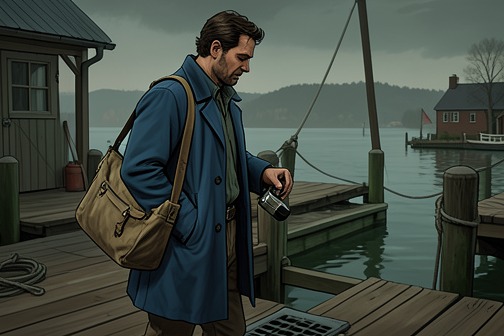
[Dan Padgett](entity:character-recall-character-dan-padgett-ce77ad7ebde1)’s loss of [Nathan Oliver](entity:character-recall-character-nathan-oliver-b08f2093009a)’s blood sample begins as a careless accident at the harbour, but its consequences extend beyond the objects that sink. The mishap provokes Oliver’s fury, creates the need for a replacement sample, and is followed by Oliver’s failure to attend the appointment arranged to provide one. A later search uncovers a phial labelled with Oliver’s name and a date, adding a separate, significant blood-sample clue to the investigation without establishing that it was the specimen lost overboard.
## The Errand and the Loss
The incident comes to [Rupert Maycroft](entity:character-recall-character-rupert-maycroft-7c5479ec084a)’s attention when [Millie Tranter](entity:character-recall-character-millie-tranter-76ef6a950909) hurries into his office, barely containing her excitement. Oliver has ordered Maycroft to come to the harbour at once: Dan has lost the blood sample. The commotion also involves several unrelated items. [Jago Tamlyn](entity:character-recall-character-jago-tamlyn-cfdf04733a3b) explains that the bag contained library books belonging to [Mrs. Burbridge](entity:character-recall-character-mrs-burbridge-b369192d32ea), shoes and handbags belonging to Dan’s mother that Dan was taking to Oxfam, and Oliver’s sample.
Dan gives Maycroft a direct account of the accident. He had the packet containing the sample, along with the other belongings, inside a canvas bag slung over his shoulder. As he leaned over the rail to look at the water, the bag slipped off. The physical explanation is plain, but the mixed contents make the mishap consequential: one dropped bag takes a medical specimen and charitable donations out of reach together.
Maycroft asks [Jago](entity:character-recall-character-jago-e24638098dea) whether the launch could have been stopped or the bag caught with a billhook. Jago says the shoes were heavy and sank quickly; he heard Dan shout, but it was already too late. His explanation establishes why the bag could not simply be retrieved, while also distinguishing the moment of loss from any deliberate disposal. The evidence presents the incident as an accident caused by the bag slipping, not as an intentional act.
## Oliver’s Anger and the Need to Repeat the Test
Oliver’s response is sharply out of proportion to the practical value he assigns to the other lost belongings. He sarcastically ranks the library’s loss and the disappointment of a pensioner seeking cheap shoes above the inconvenience of giving blood again. His controlled but staccato anger makes clear that the sample matters to him, even as he mocks the hierarchy of losses being discussed. He insists that Dan answer for what happened rather than letting Jago speak in his place.
The missing sample means Oliver must provide another. [Jo Staveley](entity:character-recall-character-jo-staveley-c3decdb22be8) later tells Maycroft that Oliver is expected at the surgery at nine the next morning to give a replacement. The prospect is unwelcome to both of them: Oliver hates the needle, while Jo notes that her professional skill makes it easier to find a vein on the first attempt. The account turns an apparently minor harbour mishap into a specific medical appointment, with Oliver’s dislike of the procedure already part of the problem.
Maycroft raises the furore at the harbour later with another person, referring to Dan as the idiot who dropped the sample. Jo confirms that Oliver is due the following morning and that she does not expect him to look forward to the needle. The replacement plan seems straightforward; its importance changes when Oliver does not arrive.
## The Missed Appointment and Oliver’s Disappearance
At nine twenty-five, Jo telephones Maycroft because Oliver has not appeared for his nine o’clock appointment. She has already called [Peregrine Cottage](entity:location-recall-location-peregrine-cottage-198d166c0380). [Miranda Oliver](entity:character-recall-character-miranda-oliver-9ff7b856bad2) says she heard her father leave at about seven-twenty but did not speak with him and does not know where he was going. [Dennis Tremlett](entity:character-recall-character-dennis-tremlett-154fb8dc6be3) is at the cottage, working, and says he has not seen Oliver since the previous day. Neither can account for his absence.
The small domestic details sharpen the uncertainty. Oliver made tea, and the pot was still warm when Miranda entered the kitchen, but he had eaten only a banana. He had not said the previous evening that he planned to go for blood. Jo considers that he might be avoiding the appointment or taking a walk, but his failure to arrive gives her cause for concern. The routine created by the lost sample has become the occasion on which his absence is noticed.
Maycroft initially weighs the island’s custom of leaving visitors undisturbed against his responsibility for Oliver’s safety. Organising a search could itself be an unwelcome intrusion if Oliver had simply gone for a walk; doing nothing could be indefensible if the older man had collapsed. After Oliver has been gone without explanation for two hours, Maycroft decides that they must begin looking. He tells Jo to notify [Guy Staveley](entity:character-recall-character-guy-staveley-dbfd0ffbc0c5), arranges to contact others, and asks her to remain at the surgery in case Oliver turns up. Thus the missed replacement appointment marks the transition from an argument about a dropped specimen to an active search for a missing visitor.
## The Blood Sample as Later Evidence
The blood-sample thread returns during the murder investigation. In a later search of [Puffin Cottage](entity:location-recall-location-puffin-cottage-fa4f56889609), [Kate Miskin](entity:character-recall-character-kate-miskin-bc49acd8ef06) and [Francis Benton-Smith](entity:character-recall-character-francis-benton-smit-367461ca9c82) discover a phial concealed beneath butter in a tub. Beneath the butter are foil and two small packages; one contains blood in a phial with Oliver’s name and a date still on its label, while the other contains a hair sample wrapped in tissue paper. The label is handwritten, allowing the sample to be identified. The find establishes that a labelled sample belonging to Oliver was concealed at the cottage, but the evidence does not identify it as the original sample that fell into the sea.
The distinction matters to the event’s place in the larger chain of evidence. The first specimen is explicitly lost with Dan’s bag, and Oliver is expected to provide another. The later discovery is a separately described, labelled phial found hidden in Dan’s cottage. It gives the investigation a concrete object to examine and connects the blood-sample episode to the search of Puffin Cottage, but it does not undo the original loss or explain by itself how the concealed phial came to be there. The accident’s significance therefore lies both in its immediate practical consequences and in the way the missing appointment and later recovered sample become distinct points in the investigation.
Event 5
Nathan Oliver threatens to disinherit the Combe Island Trust and take up permanent residence
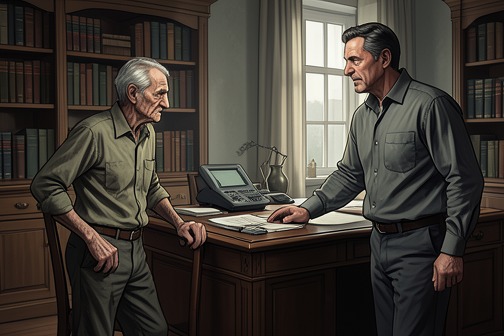
[Nathan Oliver](entity:character-recall-character-nathan-oliver-b08f2093009a)’s ultimatum to [Rupert Maycroft](entity:character-recall-character-rupert-maycroft-7c5479ec084a) turns a dispute over hospitality and accommodation into a direct challenge to the [Combe Island Trust](entity:organization-recall-organization-combe-island-tru-74926bcf751d)’s authority. Oliver threatens to remove the Trust from his will unless it guarantees his access and provides for his work, then announces that he plans to live on [Combe Island](entity:location-recall-location-combe-island-fad9a3251d49) permanently. His leverage is at once financial, personal, and legal: he is willing to redirect an inheritance, but also argues that the Trust’s own deed gives him the right to remain.
## The confrontation
The scene follows an earlier disagreement about [Atlantic Cottage](entity:location-recall-location-atlantic-cottage-5dab6bdae375). Maycroft had last seen Oliver two days before, and now notices how dramatically he seems to have aged in the interval. Oliver labors along the path, appearing physically diminished; in the study, he refuses a chair and steadies himself by gripping its back as he faces Maycroft across the desk. [Adrian Boyde](entity:character-recall-character-adrian-boyde-86baeb5a62d0) leaves silently at Maycroft’s nod, leaving the two men to speak privately. Oliver’s controlled delivery contrasts with the frailty Maycroft has just observed: his body appears weakened, but his demands are firm and deliberate.
Oliver frames his first demand through his will. He says that he has divided his estate equally between his daughter and the Combe Island Trust, and that he has no other dependants or charitable commitments. That arrangement is conditional, however. Unless the Trust assures him that he may visit whenever he chooses and provides accommodation suitable for his work, he will change it when he returns to the mainland. The threatened alteration makes the Trust’s relationship with Oliver consequential beyond the immediate question of where he can stay: its future share of his estate depends on whether it meets his conditions.
## The dispute over responsibility and access
Maycroft questions whether Oliver’s anger is a disproportionate response to an accident. Oliver rejects that account outright, insisting that [Dan Padgett](entity:character-recall-character-dan-padgett-ce77ad7ebde1) caused the incident deliberately. He also blames the Trust for allowing Dan to come to the island with his mother, whom Oliver says was already dying and unable to work as represented. These are Oliver’s accusations in the confrontation, not an independent confirmation of Dan’s intent or of the circumstances of his mother’s employment. Their force in the scene lies in how Oliver uses them to broaden the complaint: he presents the incident not as an isolated mishap but as evidence that the island’s management has failed in its responsibilities.
Maycroft does not concede that charge. He apologizes for Oliver’s sense of having been failed while distinguishing the rights established by the Trust deed from [Emily Holcombe](entity:character-recall-character-emily-holcombe-3511c23e4493)’s claim to Atlantic Cottage. He acknowledges that a person born on the island cannot be denied admission and says that, as far as the Trust knows, Oliver is the only living person entitled under that provision. But Atlantic Cottage is not simply vacant accommodation to allocate: Maycroft says Emily has a moral right to it, and that it could go to Oliver only if she agreed to move. Oliver answers by urging Maycroft to make Emily understand the cost of refusing. The exchange exposes a conflict between Oliver’s insistence on his own rights and the competing claim of someone already settled in the cottage.
## The demand to reside permanently
Oliver then makes a second demand, distinct from his request to visit: he intends to take up permanent residence on Combe Island as soon as arrangements can be made. He expects suitable accommodation and proposes that [Peregrine Cottage](entity:location-recall-location-peregrine-cottage-198d166c0380) be altered to serve temporarily while the decision about Atlantic Cottage remains unresolved. The proposal makes the dispute immediate. The Trust is not being asked only to recognize a right of admission; it must also address where Oliver will live and how his needs will be met while a longer-term arrangement is considered.
Maycroft says he will inform the Trustees and review the deed. He is unsure whether it permits permanent residents who do not work for the Trust, although he knows that Emily Holcombe’s residence is specifically provided for. Oliver counters with his own reading of the document: it says that a person born on the island cannot be refused admission, and it places no limit on the length of a stay. He therefore argues that permanent residence is legally possible without amending the Trust’s terms. The disagreement is not resolved in the study; it turns on whether the deed’s guarantee of admission also supports the lasting residence Oliver claims it does.
## Immediate consequences
Oliver leaves without waiting for a decision, shutting the door with a firmness close to a slam. Maycroft sinks into his chair, fearing that the post he had accepted as a temporary and peaceful interval may end in failure and humiliation. The Trustees know Oliver has always been difficult, but Maycroft recalls that his predecessor had managed to cope with him. The threatened change to the will has thus become a crisis for Maycroft as well as a negotiation over Oliver’s place on the island.
The confrontation is followed immediately by another report of trouble: Emily Holcombe enters to tell Maycroft that Dan has dropped Oliver’s blood sample overboard. That development does not settle Oliver’s accusation about the earlier incident, but it keeps the Padgett matter present as Maycroft confronts the ultimatum. The scene’s turn is from a dispute that might have been contained as a complaint about an accident to a broader contest over inheritance, the Trust deed, accommodation, and who has the standing to decide how Oliver may live on the island.
Event 6
Nathan Oliver catches Miranda and Dennis together and rejects their plans
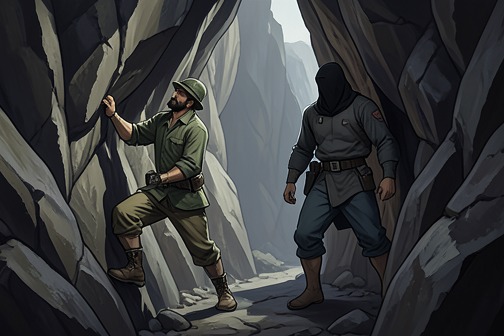
[Nathan Oliver](entity:character-recall-character-nathan-oliver-b08f2093009a) catches [Miranda Oliver](entity:character-recall-character-miranda-oliver-9ff7b856bad2) and [Dennis Tremlett](entity:character-recall-character-dennis-tremlett-154fb8dc6be3) in their concealed refuge below the cliffs and responds not with accommodation but with a demand that they leave. Their attempt to preserve their relationship while remaining in his service collapses under his anger: the discovery exposes both the intimacy they hid and their dependence on the household and work he controls.
## The Hidden Refuge
Miranda and Dennis have found a hollow on the lower cliff, about a hundred yards south of [Combe Island Chapel](entity:location-recall-location-combe-island-chapel-5a1c4443b1da) and less than three yards from a sheer forty-foot drop to a small inlet. High granite rocks enclose it, and reaching it means clambering and sliding down a steep slope strewn with boulders and tangled bushes. The boughs offer handholds, making the descent manageable even for Dennis, who is partially lame, but the difficulty also helps conceal the place. Someone would have to peer down from the friable cliff edge to see them.
Miranda has treated that possibility as too unlikely to trouble her. Desire and the optimism of hope have made the danger seem almost protective: the precarious setting enhances her feeling of invulnerability and gives their lovemaking an erotic edge. Dennis tries to share her confidence, supplying the enthusiasm he knows she expects. Their refuge is thus both an intimate space they have made for themselves and a place whose apparent privacy depends on not being seen from above.
## Discovery on the Cliff
After their urgent physical need has been satisfied, the lovers lie close together but are distant in thought, facing the sky. Their clothes are scattered beside them, with Miranda’s binoculars thrown over the heap. Dennis’s heightened attention to the island’s sounds and smells belongs to the quiet aftermath of their intimacy; the sudden interruption comes from above. As Miranda stretches over him, she freezes, her face turning white with fear. Dennis struggles free and reaches for his jeans before looking up.
At first he sees only a dark, motionless figure blocking the light at the upper edge of the cliff. Recognition resolves the threat: the watcher is Nathan Oliver. The staging of the moment makes the refuge’s vulnerability immediate. The same overlook that had seemed an improbable danger has become the vantage point from which Miranda’s father sees her with Dennis. The secret is no longer theirs to manage privately.
## Miranda’s Appeal and Oliver’s Anger
The confrontation continues indoors. When Miranda faces her father, his expression appears rigid and lifeless; only the pulse above his right eye betrays the bitterness he is struggling to control. She says they had not meant him to discover the affair in this way. Oliver answers with scorn, saying he already knew in San Francisco that she had found someone, but condemning her choice of Dennis as a poor, disabled employee. He also invokes her age, his will, her expected inheritance, and her domestic skills in a degrading calculation of the advantages she might have offered another man.
Miranda had expected a difficult discussion, but had hoped they could reason together and decide what would be best for everyone. That hope disappears under the force of his anger. She tells him that she and Dennis love each other and want to marry. Oliver points out that they are both adults and do not require his consent, then asks whether Dennis has any legal impediment to marriage. His response does not amount to acceptance: the practical question is followed by rejection of the future they have imagined.
## A Future Oliver Refuses
Miranda proposes that marriage need not alter her father’s life. She and Dennis could work by the day; they could find a reliable woman to take over her household duties so Oliver would not be alone at night, and they could accompany him on tour as before. She insists that nothing need change. Oliver rejects both the arrangement and its premise. He says he does not need a daily woman or a night nurse, and that help could be hired if required. He has no intention of employing a married couple, making Dennis’s position—and Miranda’s continued place in the household—part of the conflict.
Miranda then identifies the work and care she believes Oliver is discounting. On tour, she checks his hotel room, runs his bath, complains when arrangements are wrong, helps organise signing sessions, protects his public reputation, and ensures he gets the food and wine he likes. She also stresses Dennis’s value as Oliver’s secretary and copy-editor, describing him as more than an employee: he edits beyond the copy-editing level, helps with plotting, and serves as a sounding board. Her appeal reveals how much Oliver’s household and literary life rely on the very couple whose relationship he refuses to accommodate.
## The Ultimatum
Oliver tells Miranda to decide with Dennis what they intend to do. If she chooses a life with him, Oliver says he will not expect her back at the London house and wants Dennis to return the flat’s keys. Until then, she must tell no one. Although the island is small, Oliver says there should be room enough for them to avoid one another during the next twenty-four hours. He has another ten days booked at [Combe House](entity:location-recall-location-combe-house-dd6545e484e5), where he can take his meals, and plans to book the launch for the following afternoon. He expects Miranda and Dennis to be on it.
The encounter therefore ends not with a negotiated compromise but with a deadline and a forced choice. Miranda’s proposal had tried to keep love, family care, and work together; Oliver treats those ties as arrangements he can terminate. His final instructions extend the rupture beyond employment and residence to secrecy, requiring that they tell no one while they prepare to leave. The scene’s decisive reversal is that the lovers’ hidden place, chosen as a refuge from scrutiny, becomes the beginning of their expulsion from the life they had hoped to preserve.
Event 7
Nathan Oliver and Mark Yelland clash over Yelland’s laboratory and Oliver’s novel
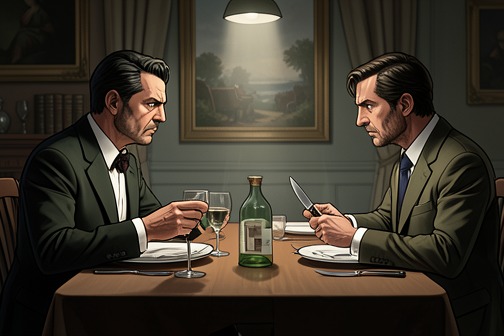
At a formal dinner on [Combe Island](entity:location-recall-location-combe-island-fad9a3251d49), Mark Yelland challenges [Nathan Oliver](entity:character-recall-character-nathan-oliver-b08f2093009a) over the portrayal of a laboratory director in Oliver’s forthcoming novel and over Oliver’s investigation of Yelland’s research. The confrontation turns a disagreement about fiction and scientific practice into a contest over who may speak, what the public has a right to know, and whose suffering counts. Its restrained setting sharpens the hostility: the men observe the courtesies of a shared meal while treating one another as rivals.
## Background and Stakes
The confrontation follows Oliver’s inquiries into the organization of Yelland’s laboratory. Yelland says that Oliver met a junior member of his staff and questioned him about the laboratory, including the validity of its work, the treatment and suffering of the primates, and how the employee justified his role. He objects not only to the questions but to the disclosure of information by someone he says had no right to reveal it. Oliver’s research, therefore, has already crossed from private investigation into consequences for the laboratory and one of its employees.
The novel gives that conflict a public dimension. Yelland has read proofs of Oliver’s book and suspects that its laboratory director is intended as a portrait of himself. Because the novel is due to appear the following year and Oliver’s work carries influence, Yelland fears readers will identify him with the character. He believes he cannot sue and does not want publicity, yet he also says the book could become a gift to the animal-liberation movement. For him, the risk is not merely personal embarrassment: his research and his family may be endangered by a portrayal that he expects the public to treat as fact.
## The Dinner Confrontation
The exchange begins during the main course. Yelland lays down his cutlery and addresses Oliver across the table, accusing him of making the fictional director arrogant and unfeeling. Oliver, still looking at his plate, denies that he has used Yelland as a model. He says that he does not know him and that he draws on himself, rather than borrowing a living person, for his art. The contrast is immediate: Yelland sees a recognizable portrait and its likely effects; Oliver rejects the premise that his character is a disguised likeness.
Yelland then turns from the novel to Oliver’s research methods. He wants to know how Oliver obtained the junior employee’s name and argues that the questioning involved more than routine background information. Oliver describes his purpose more narrowly: he wanted facts about staffing, animal housing and feeding, and how the animals were obtained. He says that he sought information about how people act rather than how they feel, adding that he already knows how they feel. The claim provokes Yelland, who answers that he and his colleagues feel for patients with Parkinson’s disease and cystic fibrosis and work toward cures at personal sacrifice.
Oliver counters that the animals bear the suffering while researchers receive the distinction. He accuses scientists of being willing to let monkeys die, perhaps in discomfort, in pursuit of being first to publish, and compares the competition for scientific glory to the commercial marketplace. Yelland replies that Oliver’s concern for animals is inconsistent with the ordinary consumption of meat and the wearing of leather. Oliver accepts that he is a carnivore and that he eats meat, while distinguishing food from the use of primates in experiments that cannot benefit the animals themselves. He challenges the assumption that human beings, as a supposedly superior species, are entitled to exploit other species at will. He also acknowledges that the [Home Office](entity:organization-recall-organization-home-office-3de7115d68d1) monitors permissible pain and seeks clarification about analgesics, treating that oversight as a limited alleviation rather than a resolution of the moral issue.
## Disagreement Beyond the Two Men
The dinner does not settle the ethical dispute; it reveals how differently the participants define responsibility. Oliver disclaims a strong personal position on animal experimentation and says that his characters hold views that are not necessarily his own. Yelland calls that answer a evasion: a novelist gives characters a voice, sometimes a dangerous one, and Oliver cannot separate that voice from the consequences of the information he has gathered. Their argument thus concerns not only the treatment of animals but the effects of representation and disclosure.
Yelland makes those consequences concrete. He says the junior employee has resigned and was one of his most able young researchers, now lost to important work and perhaps to science altogether. Oliver responds that the employee’s decision may call his commitment into question, then challenges Yelland’s own access to tightly controlled proofs. Yelland answers that the distribution was not controlled tightly enough and suggests that there are subversives in publishing houses as well as laboratories. The exchange leaves the source of Yelland’s copy unexplained, while showing that the novel’s circulation has itself become part of the conflict.
Other diners register the strain without resolving it. Jo argues that some animal-rights protesters may be motivated by genuine compassion, distinguishing them from violent protesters who seek excitement. Yelland answers that violence and intimidation may drive research out of the United Kingdom to countries with weaker statutory protections, where animals could suffer more, while the country also loses economically. [Rupert Maycroft](entity:character-recall-character-rupert-maycroft-7c5479ec084a) attempts to widen the discussion by suggesting that people with neurological diseases, or parents whose children have them, might have a particular claim to speak on the moral validity of the experiments. Oliver says he did not begin the argument and does not wish to speak on behalf of patients. The interventions expose competing claims to moral authority—patients, researchers, animal advocates, and the novelist—without producing agreement.
## Departure and Consequences
Oliver ends the exchange on his own terms. After finishing his guinea fowl, he places his knife and fork carefully side by side, rises, and says that the evening has provided sufficient stimulation. He declines Maycroft’s offer to order the buggy, insisting that he is not yet decrepit, and says he will walk back to [Peregrine Cottage](entity:location-recall-location-peregrine-cottage-198d166c0380). Before leaving, he reminds Maycroft that he needs the launch the following afternoon. The request does not clarify whether Oliver intends to leave the island, and the uncertainty remains after his departure.
Yelland, meanwhile, tells Maycroft that Oliver’s novel will have influence and that the island is not large enough for both of them. He says he hopes Oliver will leave, and withdraws before coffee rather than continue the dinner. Staveley questions whether the disputed information is not something everyone has a right to know; Yelland insists that disclosure is unacceptable when it may jeopardize life-saving research or place information in the hands of people he considers ignorant. The scene ends without reconciliation or a settled account of the laboratory. Instead, it establishes the novel, the employee’s resignation, and the threatened research as linked sources of pressure, while leaving Oliver’s next move open.
Event 8
Nathan Oliver is found hanging at the lighthouse
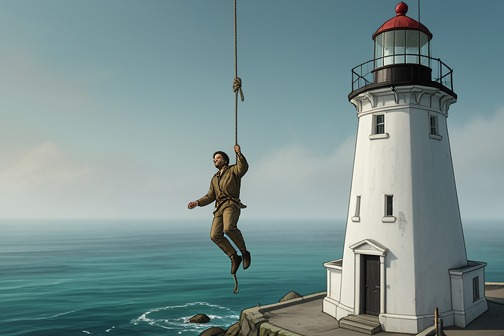
[Nathan Oliver is found hanging at the lighthouse](entity:event-recall-event-nathan-oliver-is-found-ea509a7e379e) after he fails to appear for a scheduled blood sample and a search is organized across [Combe Island](entity:location-recall-location-combe-island-fad9a3251d49). The discovery, made by [Rupert Maycroft](entity:character-recall-character-rupert-maycroft-7c5479ec084a) as the mist lifts, transforms a morning of uncertainty into the sight of Oliver’s suspended body against the lighthouse’s white walls and the suddenly clear sea. The search party’s arrival makes the death a collective shock, but the first view belongs to Maycroft, alone beside the tower as the landscape returns to focus around him.
## The unexplained absence
At nine twenty-five, [Guy Staveley](entity:character-recall-character-guy-staveley-dbfd0ffbc0c5) telephones Maycroft from the surgery: Oliver was due at nine for another blood sample and had not arrived. The appointment gives the absence an immediate, practical frame, but the information from [Peregrine Cottage](entity:location-recall-location-peregrine-cottage-198d166c0380) deepens the unease. [Miranda Oliver](entity:character-recall-character-miranda-oliver-9ff7b856bad2) had heard her father leave at about seven twenty; they had not spoken, and she did not know where he was going. He had made tea, but eaten only a banana. [Dennis Tremlett](entity:character-recall-character-dennis-tremlett-154fb8dc6be3), already at the cottage to work, had not seen him since the previous day.
Oliver might simply have gone for a walk or chosen to miss the appointment, and Maycroft recognizes that a search could add needless irritation if that were all. Combe Island’s custom of leaving visitors in peace makes intervention feel like a breach of ordinary practice. Yet Oliver is no longer young, and he has been gone for two hours without explanation. Maycroft weighs that discretion against the possibility that Oliver lies incapacitated by a stroke or heart attack, and against his own responsibility as the person in charge. He decides that the search must begin.
## A search in the fog
Maycroft asks Guy Staveley to be told and arranges for people to meet at the house, while Guy remains at the surgery in case Oliver appears. [Adrian Boyde](entity:character-recall-character-adrian-boyde-86baeb5a62d0) volunteers to call at Peregrine Cottage and search the island’s north-east. Maycroft asks him to play down the fuss if he finds Oliver, mindful that someone anxious about giving blood might be unsettled by a search party. The effort is thus organized around two possibilities that cannot yet be reconciled: Oliver may be avoiding the appointment, or he may be in danger.
Within five minutes, a small group has assembled: Guy Staveley, [Dan Padgett](entity:character-recall-character-dan-padgett-ce77ad7ebde1), and [Emily Holcombe](entity:character-recall-character-emily-holcombe-3511c23e4493), who is at the surgery for her annual anti-flu injection. [Jago Tamlyn](entity:character-recall-character-jago-tamlyn-cfdf04733a3b) has been summoned but has not yet arrived. [Arthur Roughtwood](entity:character-recall-character-arthur-roughtwood-5dd20407812f) refuses to help, saying he is too busy. Before Maycroft can direct a wider search, the island’s mist thickens. It veils the sea, obscures [Combe House](entity:location-recall-location-combe-house-dd6545e484e5), and leaves the lighthouse cupola appearing isolated above the fog. With visibility closing in, Maycroft limits the immediate search to the lighthouse rather than sending people farther across the island.
## The discovery
Maycroft leads the others toward the lighthouse, but the mist separates the group: voices fade, and the figures behind him disappear from view. The lighthouse suddenly looms ahead. Its door stands ajar. Maycroft enters, switches on the light, climbs the first flight past the fuel room, and goes halfway up the second, calling Oliver’s name. There is no answer and no light to suggest anyone is inside. Back at the doorway, he calls to the others to stay where they are, then moves without a clear purpose around the building to its seaward side.
As Maycroft stands against the sea wall, the mist begins to lift. The lighthouse, sea, and sky gradually regain their familiar outlines; then he sees Oliver’s body high against the tower. A climbing rope is taut between the body and the white railings. Oliver’s neck is stretched and mottled, his head dropped to one side, and his hands turn palm-outward. His shoes are still on, although for an instant the disorientation of the sight makes his feet seem exposed. The composition’s apparent gesture of benediction does not soften the evidence of death; it makes the body’s posture more disturbing.
## Witnesses and significance
For a moment, Maycroft experiences time as suspended. He hears no sound of his own, only the shriek of a gull. Then he sees [Jago](entity:character-recall-character-jago-e24638098dea) and [Millie Tranter](entity:character-recall-character-millie-tranter-76ef6a950909) to the right of the lighthouse. [Millie](entity:character-recall-character-millie-cbf710cfdc05) is staring upward and screaming continuously. The rest of the search party comes around the curve of the tower, bringing a gathering of moans, cries, and exclamations into the scene. Their arrival turns Maycroft’s solitary discovery into a communal encounter with Oliver’s death, while Millie’s scream and the gulls’ cries pierce the group’s confused response.
The sequence is shaped by a reversal of visibility: the mist first makes the island and its landmarks strange, hides the searchers from one another, and delays recognition; when it withdraws, it reveals the body with stark clarity. The discovery resolves the immediate question of where Oliver has gone, but not why he is dead or how he came to be hanging from the railings. The body’s position presents an apparent hanging, not an explanation. Those unanswered questions remain beyond this moment, which closes on the search party gathered beneath the lighthouse and the sudden, irreversible knowledge that Oliver is dead.
Event 9
The disappearance of three German officers on Combe Island
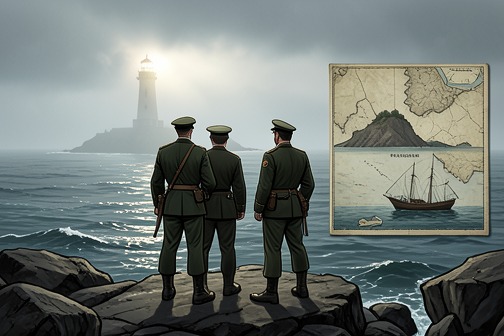
[The disappearance of three German officers on Combe Island](entity:event-recall-event-combe-island-51aae907ad89) during the [Second World War](entity:time-recall-time-second-world-war-80275f3e28b5) is both a wartime mystery and a story about how families and communities preserve—or suppress—the past. The men were officially posted as missing, believed drowned, but their fate emerged only through a belated chain of inquiry and testimony, in which the island’s history and the Oliver family’s silence shaped what could be known.
## Background and the First Account
[Raimund Speidel](entity:character-recall-character-raimund-speidel-976a55c3f9a3)’s search began with a family history that had treated his father’s disappearance as a convenient end to an already failing marriage. His mother came from a distinguished Prussian military family, which regarded the marriage as a misalliance; her relatives were also dissatisfied that her husband served with the occupying force on Guernsey rather than in a more prestigious regiment or role. The family learned that he and two fellow officers had gone to [Combe Island](entity:location-recall-location-combe-island-fad9a3251d49) after it was believed evacuated. After an investigation disclosed the excursion, they were presumed lost at sea. Their deaths ended the marriage without divorce or public ignominy, though not with the military glory the family might have preferred.
The official record Speidel eventually found was more specific about the men’s departure, but not their fate: the three young officers had gone absent without leave, taking a thirty-foot sailing boat fitted with an engine, and never returned. They were listed as missing, believed drowned. Speidel did not know whether their journey had been authorized by their commanding officer, and suspected it had not been. A fellow officer, bound by secrecy about what the father had confided, supplied a possible purpose: the men intended to raise the German flag on a small island off the Cornish coast, perhaps to demonstrate that it could be done. Combe Island seemed the only possible destination, but the plan remained an inference rather than an established fact.
The silence persisted into the next generation. Speidel had been told little about his father as a child and came to understand that questions were unwelcome. When his twelve-year-old son asked about his grandfather and resented the absence of any recorded or spoken account, Speidel promised to investigate. Official sources offered little; a retired fisherman, more than eighty years old, provided some information when Speidel visited Cornwall the previous year, though local suspicion made inquiry difficult. His eventual journey to Combe Island thus pursued more than a missing wartime record: it sought to recover a history that the family had left unspoken and that local memory had not readily surrendered.
## The Lighthouse Fire and Its Conflicting Accounts
Before the wartime episode, Combe Island already carried a history of violence. The family had acquired it in the sixteenth century, after Mediterranean pirates had used it as a base to raid southern English coasts and seize people for enslavement. The island’s reputation for imprisonment, rape, and torture persisted in local memory, making it difficult to find temporary staff. During the [Phoney War](entity:time-recall-time-70b861d9e914), the island remained occupied, but in October 1940, after the fall of France and the death of [Emily Holcombe](entity:character-recall-character-emily-holcombe-3511c23e4493)’s brother at Dunkirk, her parents decided to leave. The last staff were taken to the mainland by [Saul Oliver](entity:character-recall-character-saul-oliver-28c8ea15bc4d) and the steward; Saul then returned with his young son Nathan, saying he had final tasks to complete and that the house was not secure.
Emily Holcombe later dated the episode to the night of October 10, 1940, but her account was not eyewitness testimony: years afterward, Saul had told her what happened when he was barely coherent and within two weeks of his death. Three German officers from the occupied Channel Islands landed on Combe. Their purpose remained uncertain; they may have been on reconnaissance or pursuing a private venture, and Raimund Speidel thought they might have intended to raise the German flag on the disused lighthouse. After first light, the men climbed the tower. Saul found their boat and, knowing that the lighthouse’s ground floor stored dry animal fodder, set the straw alight. The flames and smoke rose into the upper chamber. The officers could not escape to the lantern: its railings were unsafe and its door had been nailed shut. All three probably suffocated.
According to Saul’s account, he waited for the fire to burn out, found the bodies halfway up the tower, carried them to the officers’ boat, and scuttled it in deep water using the dinghy from his own sailing boat. Emily said Saul had taken both Nathan and [Tom Tamlyn](entity:character-recall-character-tom-tamlyn-9b2260767b74), [Jago Tamlyn](entity:character-recall-character-jago-tamlyn-cfdf04733a3b)’s grandfather, with him. She also reported Saul’s claim that four-year-old Nathan had started the fire while playing with matches found in the house. The boy panicked and denied being near the lighthouse; Emily had believed Saul at the time, but later doubted the story. Nathan himself, as far as she knew, never spoke of the episode.
The return journey left another unresolved death. Saul said Tom Tamlyn fell overboard during the stormy crossing to the mainland. His body washed ashore six weeks later, and the damaged skull yielded little evidence beyond a blow to the back of the head. The coroner returned an open verdict, while the Tamlyn family believed Saul had murdered Tom to conceal what had happened on Combe. Thus the officers’ disappearance was bound to a second suspected killing, with the surviving accounts divided between an accident, wartime concealment, and a child’s possible role in the fire.
## The Story's Uncertain Inheritance
Emily Holcombe’s account reached [Adam Dalgliesh](entity:character-recall-character-adam-dalgliesh-461a7125784e) through a long and fragile chain of memory. Saul Oliver told her his version years after the fire, when he was barely coherent and within two weeks of death. Holcombe had lost touch with him during and after the war, and had only rarely returned to the West Country after going to London to drive an ambulance and then resuming her studies at Oxford. She could not be certain whether Saul had wanted to confess or boast; although she thought he had told her as much as he was prepared to reveal, his account remained a deathbed recollection shadowed by earlier rumours, not a fully verified record.
The gaps between the sources are part of the event’s lasting significance. Official records established that the officers went absent without leave and were presumed drowned; family silence, local suspicion, and Saul’s late testimony supplied competing explanations without settling every detail. Holcombe herself revised her confidence in Saul’s claim that Nathan had started the fire, and resisted treating that uncertain childhood story as an explanation for [Nathan Oliver](entity:character-recall-character-nathan-oliver-b08f2093009a)’s later death. She regarded Raimund Speidel as humane and Jago Tamlyn as someone who had had many opportunities to act if he meant to kill Nathan. The wartime disappearance therefore returns not as a closed case but as an inherited secret whose partial disclosure casts suspicion forward while leaving its central uncertainties intact.
## Testimony and the Limits of Certainty
Holcombe presents her account not as the whole truth but as the portion she can attest to, while Dalgliesh listens and watches her across the room. The disclosure arrives through nested testimony: the investigator hears Holcombe, who is recalling Saul Oliver’s late account, itself shaped by what he chose to say and by the rumors that had circulated before he spoke. That structure leaves the officers’ fate more fully imagined than officially established. The fire, the bodies, and the scuttled boat explain how the disappearance might have occurred; they do not turn a family recollection into a verified record, or resolve the lingering questions about the deaths surrounding it.
Event 10
Nathan Oliver’s murder
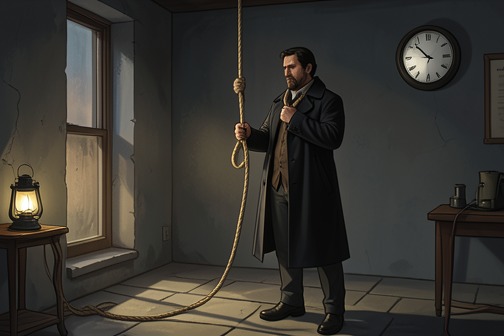
[Nathan Oliver’s murder](entity:event-recall-event-nathan-oliver-s-murder-7fd774a9ccc5) is the staged killing at the centre of the investigation on [Combe Island](entity:location-recall-location-combe-island-fad9a3251d49): Oliver died by manual strangulation, and his body was subsequently hanged from the lighthouse railings with a climbing rope. The distinction between the actual cause of death and the appearance of the body reshapes the case. Evidence about when Oliver left his cottage, who tried to meet him, and what had been concealed later provides investigators with a more complicated trail than the apparent hanging first suggests.
## Background and the Morning Timeline
Oliver visited Combe Island regularly, spending two weeks there each quarter. On this visit he arrived on Monday with his daughter, [Miranda Oliver](entity:character-recall-character-miranda-oliver-9ff7b856bad2), and his secretary, [Dennis Tremlett](entity:character-recall-character-dennis-tremlett-154fb8dc6be3). According to Miranda, he left [Peregrine Cottage](entity:location-recall-location-peregrine-cottage-198d166c0380) at about 7:20 on the morning he was killed, without his customary cooked breakfast. That account placed his departure well before the body was found, but did not establish where he went or when he died.
At ten o’clock, [Rupert Maycroft](entity:character-recall-character-rupert-maycroft-7c5479ec084a) discovered Oliver’s body. [Daniel Padgett](entity:character-recall-character-daniel-padgett-76ad82e20c20), [Guy Staveley](entity:character-recall-character-guy-staveley-dbfd0ffbc0c5), [Jago Tamlyn](entity:character-recall-character-jago-tamlyn-cfdf04733a3b), [Millie Tranter](entity:character-recall-character-millie-tranter-76ef6a950909), and [Emily Holcombe](entity:character-recall-character-emily-holcombe-3511c23e4493) soon joined him. The first reconstruction allowed for the strangulation to have occurred either in the room beneath the lighthouse lantern or on the circular platform above; the precise location remained uncertain. Investigators’ early account also described the body being hauled over the railings after the rope had been fastened around Oliver’s neck.
[Raimund Speidel](entity:character-recall-character-raimund-speidel-976a55c3f9a3) added a second, potentially significant appointment to the morning’s chronology. He said he had arranged to meet Oliver at the lighthouse at eight o’clock. Though feverish and late to set out, he arrived at 8:06 and could not enter because the door was locked. He said he had walked, passing [Atlantic Cottage](entity:location-recall-location-atlantic-cottage-5dab6bdae375) before descending to the under-cliff path, and that he had hoped to go unobserved. His account supplied a possible reason for his presence near the lighthouse, while leaving open whether Oliver had received the appointment note and whether the meeting had taken place.
Millie Tranter’s handling of that note further unsettled the timeline. She said she had put it in the letterbox at Peregrine Cottage, but admitted she had read it because it was open. She had told [Jago](entity:character-recall-character-jago-e24638098dea) about the proposed meeting and initially reasoned that there had been no urgency because the appointment was not until eight. The note’s journey and delayed delivery therefore became part of the question of how Oliver came to be at the lighthouse that morning.
## Forensic Findings and the Staged Hanging
At the initial examination, Professor Glenister assessed the time of death as between 7:30 and 9:00 a.m., probably nearer the earlier time. Rigor was well established. The conspicuous ligature mark around Oliver’s neck and the bruise beneath his right ear might have suggested hanging, but closer examination disclosed two separate circular bruises on the left side of his neck, probably made by fingers. The knot obscured the area where a thumb mark might otherwise have been visible.
Glenister concluded that Oliver had been strangled before he was hanged. The rope’s surface had left a regular, repeated pattern unlike the mark expected from an ordinary rope; she considered a climbing rope with a strong core and patterned outer covering a possible match. The later autopsy confirmed asphyxiation caused by manual strangulation and found considerable internal damage. A fracture of the superior cornu of the thyroid indicated localized pressure from a sharp grip, while a small bruise at the back of the neck showed that Oliver’s head had been forced against something hard. Glenister ruled out the possibility that he had inflicted the neck injury on himself to make a suicide appear to be murder.
The autopsy also qualified the physical circumstances of the attack. Oliver was sixty-eight and in fairly good general condition, but his neck was comparatively narrow and he was frailer than he looked; great violence was not necessary to cause the fracture. He had extensive arthritis in his right hand, and a slight callus on his forefinger suggested that he wrote by hand. These findings did not identify the assailant, but they made the injuries harder to reconcile with a self-inflicted attempt to create a false impression.
## Evidence After the Death
Investigators learned that someone had tried to wipe the climbing rope along its entire length. The laboratory might still identify what had been used to clean it, but the rope’s surface was unlikely to yield much evidence. The cleaning attempt added a further sign of concealment to a death already altered to look like hanging; it did not, by itself, establish who had handled the rope.
A later search of [Puffin Cottage](entity:location-recall-location-puffin-cottage-fa4f56889609) produced another concealed item of evidence. Beneath the top layer of butter in a tub, [Kate Miskin](entity:character-recall-character-kate-miskin-bc49acd8ef06) and [Francis Benton-Smith](entity:character-recall-character-francis-benton-smit-367461ca9c82) found two small foil-wrapped packages: one held a blood phial still labelled with Oliver’s name and the date, and the other a hair sample wrapped in tissue. Benton noted that the label was handwritten and expected it to permit clear identification. The discovery extended the investigation beyond the lighthouse scene, providing physical evidence whose handling and concealment investigators could examine alongside the reconstructed morning timeline.
## Significance to the Investigation
The murder’s central reversal is forensic and literal: the rope explains how Oliver’s body was displayed, not how he died. The time-of-death estimate, Miranda’s account of his 7:20 departure, Speidel’s missed eight o’clock meeting, and [Millie](entity:character-recall-character-millie-cbf710cfdc05)’s disclosure about the note all give the morning competing points of reference. None of those details alone resolves the sequence, and the evidence presented here does not name the killer. Together with the manual-strangulation findings and the cleaned rope, they establish that the apparent hanging must be read as a deliberate staging rather than a sufficient explanation of Oliver’s death.
Event 11
Adrian Boyde’s murder
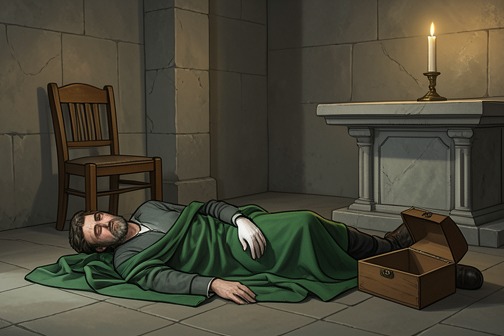
[Adrian Boyde’s murder](entity:event-recall-event-adrian-boyde-s-murder-0d7250f57f7b) is discovered in [Combe Island Chapel](entity:location-recall-location-combe-island-chapel-5a1c4443b1da), where his battered body has been covered with a green embroidered cope. The killing turns Dalgliesh’s investigation into a second murder case and confronts him with the possibility that his own earlier watchfulness might have mattered.
## Discovery and the chapel scene
After finding Boyde’s bed made at [Chapel Cottage](entity:location-recall-location-chapel-cottage-1b5c764e0dfb), Dalgliesh crosses to the chapel and discovers him lying on the stone floor, a foot from the improvised altar. The cope covers almost all of him; one stiff white hand protrudes from its edge, and dark blood shows through the green silk. Nearby, a folding chair has been opened to support a long cardboard box, its tissue paper spilling out. The scene’s carefully placed objects make the chapel a crime scene as well as the setting for a disturbing tableau.
## Confirming the killing and reconstructing the night
Dalgliesh treats the discovery as a murder, not an accident or suicide, and reports it to [Rupert Maycroft](entity:character-recall-character-rupert-maycroft-7c5479ec084a) by telephone. He tells him that [Adrian Boyde](entity:character-recall-character-adrian-boyde-86baeb5a62d0) has been murdered in the chapel and requires everyone on the island to be brought together. The investigation has changed scale: the death is no longer an isolated earlier crime but a second killing demanding an immediate response.
On returning to the chapel in search gloves, Dalgliesh finds no identifiable footprints on the sandy turf. His examination beneath the cope reveals that Boyde’s face has been brutally smashed: the nose is broken into splinters of bone, and both eyes are obscured or destroyed by the swollen, congealed blood. The stiffness of the fingers and neck, together with established rigor mortis, indicates that Boyde died the previous night. Dalgliesh cannot determine how the killer reached him: the assailant might have been waiting inside, watching from outside in the darkness, or following him from [Combe House](entity:location-recall-location-combe-house-dd6545e484e5) across the scrubland.
[Kate Miskin](entity:character-recall-character-kate-miskin-bc49acd8ef06) likewise reads the facial injuries as evidence of violence beyond simply bringing Boyde down. She considers whether Calcraft first felled him with a stone or another object and then continued the assault, driven by hatred or a complete loss of control. The distinction remains uncertain, but the possibility that the face was battered in a frenzy gives the killing a different character from a straightforward blow intended only to incapacitate.
The scene also leaves Dalgliesh with a personal sense of failure. He thinks that if he had stayed outside [Seal Cottage](entity:location-recall-location-seal-cottage-fd5d3c67ba74) a few minutes longer the night before, watching for Boyde’s return, he might have seen a second figure emerge from the darkness. While he was conferring with Kate Miskin and [Francis Benton-Smith](entity:character-recall-character-francis-benton-smit-367461ca9c82), the killer may already have been acting. Standing beside Boyde’s body, he feels grief sharpened by the knowledge that there had been no evidence suggesting another person was in danger and no grounds to detain a suspect on vague suspicion; that explanation does not lessen his burden.
## The cope as evidence
Kate Miskin has to steady her voice before assessing the attack. The smashed face and congealed blood suggest to her that Boyde may first have been felled with a stone or another object, then struck again in an assault driven by hatred or a sudden loss of control. She recognizes the possibility of a frenzy in which a killer, horrified by the deed, lashes out as though destroying the victim’s face could erase it. Her response is not only professional: alongside revulsion and anger, she feels pity, an emotion she finds harder to bear.
Francis Benton-Smith notices that the cope itself may help reconstruct what happened. Boyde was unlikely to have been wearing it when he fell, since it would probably have been beneath him; the killer may instead have taken it from the cardboard box. Tissue paper remains in the chapel, but there is no string, an unexplained detail that leaves open whether the box was already open when the killer entered.
## A vigil in the chapel
The discovery becomes, for Dalgliesh, more than a procedural turning point. Motionless beside Adrian Boyde, he listens beyond the waves’ rhythmic crash against the granite, letting the sea’s perpetual sound settle into a lament for suffering that cannot be healed. A witness might have mistaken his bowed stillness for reverence; the impression is not wholly wrong, though his vigil holds sorrow as well as respect. The murder leaves him with a burden he cannot undo or explain away, only accept and carry forward.
Event 12
1940年康姆岛灯塔火灾
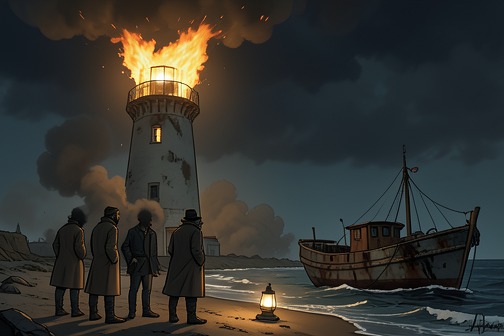
The 1940 lighthouse fire on [Combe Island](entity:location-recall-location-combe-island-fad9a3251d49) killed three German visitors and was concealed as an accident. Recounted decades later through [Emily Holcombe](entity:character-recall-character-emily-holcombe-3511c23e4493)’s account of [Saul Oliver](entity:character-recall-character-saul-oliver-28c8ea15bc4d)’s confession, the event remains shadowed by uncertainty over who started the blaze—and by the deliberate concealment of the deaths that followed.
## Evacuation and the Germans’ Arrival
When war began, Combe Island was evacuated because there was not enough fuel for its launch. Emily Holcombe’s family remained through the [Phoney War](entity:time-recall-time-70b861d9e914), but in October 1940, after the fall of France and her brother’s death at Dunkirk, her parents decided to leave. On 10 October, after taking the remaining staff to the mainland, Saul Oliver and his son returned to the island in Saul’s sailing boat. Saul said he had final tasks to complete and was concerned that the house was not secure.
During that night, three Germans from the occupied Channel Islands landed on Combe. Their purpose was uncertain: they may have been conducting reconnaissance or pursuing a private enterprise. [Raimund Speidel](entity:character-recall-character-raimund-speidel-976a55c3f9a3) later suggested that they might have intended to plant a German flag atop the disused lighthouse. After first light, the men climbed the tower, apparently to survey the area.
## The Fire and Its Concealment
The lighthouse’s ground floor was being used to store animal fodder and was packed with dry straw. In Saul’s account, he found the Germans’ boat and worked out where they had gone. He then set the straw alight. Smoke and flames rose into the tower, trapping the men: they could not escape onto the lantern because its railings had become unsafe, and the door had long been nailed shut to prevent accidents. All three died, probably by suffocation.
After the fire burned out, Saul found the bodies halfway up the tower and carried them back to the Germans’ boat. He took the boat out with the dinghy from his sailing boat and sank it in deep water. The deaths were thus hidden along with the visitors’ means of arrival. According to Emily, no inquiries followed the war; the young men were probably listed as missing, presumed drowned.
## Conflicting Accounts and Belated Confirmation
Emily’s knowledge came from Saul, who told her the story when he was barely coherent and within two weeks of his death. She could not tell whether he meant to confess or boast, and believed she had received only as much of the truth as he was willing to disclose. The account was supported by objects he had kept—a revolver, binoculars and a compass—but for years those souvenirs were the only evidence beyond his words.
Saul’s account also shifted the question of responsibility. He later told Emily that it was the boy, [Nathan Oliver](entity:character-recall-character-nathan-oliver-b08f2093009a), who had lit the straw while playing with matches found in the house. Nathan panicked and denied having been near the lighthouse. Emily believed Saul at the time, but later became unsure whether his claim was true. Raimund Speidel’s arrival on Combe Island, decades after the fire, provided the first confirmation of the story beyond Saul’s souvenirs. The delayed disclosure makes the fire more than a concealed wartime death: it leaves Nathan’s childhood act—or Saul’s version of it—unresolved, and brings the island’s buried history into the present.
Event 13
Tom Tamlyn’s death at sea
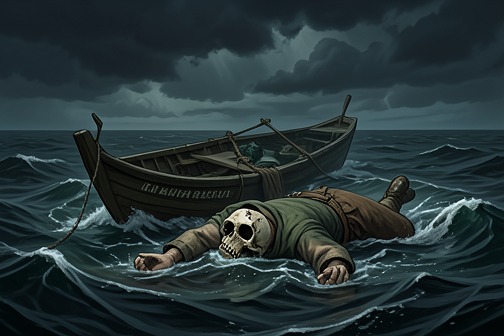
[Tom Tamlyn’s death at sea](entity:event-recall-event-tom-tamlyn-86e5fb58e7bb) is the unresolved aftermath of a wartime killing on [Combe Island](entity:location-recall-location-combe-island-fad9a3251d49): after helping [Saul Oliver](entity:character-recall-character-saul-oliver-28c8ea15bc4d) dispose of three German officers’ bodies, Tamlyn disappeared during their return voyage to the mainland. Saul called the fall overboard an accident, but the evidence and the Tamlyn family’s enduring suspicion left open the possibility that he had been murdered to conceal what happened on the island.
## The wartime departure
Miss Holcombe’s account places Tamlyn’s death after the killing of three German officers on Combe Island. Saul had taken his young son Nathan with him, and Tamlyn, [Jago](entity:character-recall-character-jago-e24638098dea)’s grandfather, was also involved. Once Saul and Tamlyn had scuttled the boat and destroyed most of the evidence, they returned to the island. Later, with the child, they set out for the mainland in darkness. The crossing was made in stormy weather, and Tamlyn did not reach shore alive.
## The body and the unresolved account
[Tom Tamlyn](entity:character-recall-character-tom-tamlyn-9b2260767b74)’s body supplied evidence but no resolution. It washed ashore six weeks after the stormy crossing, farther down the coast, and was too incomplete to yield much information; the back of the skull, however, had been smashed. Saul Oliver said the injury happened in an accident when Tamlyn fell overboard while helping control the boat. The coroner returned an open verdict, leaving the official account undecided rather than confirming either accident or murder.
The family’s interpretation hardened where the inquiry had stopped. [Jago Tamlyn](entity:character-recall-character-jago-tamlyn-cfdf04733a3b) later said that his father had learned the story from Saul, mostly when Saul was drunk, and that older people in [Pentworthy](entity:location-recall-location-pentworthy-9026651adaf8) had repeated it too. In Jago’s account, Tamlyn was the better seaman, not a man likely to fall overboard by accident; he therefore believed Saul had killed his grandfather and thrown him into the sea. The smashed skull and the absence of witnesses made the accusation impossible to prove, but, for the Tamlyns, lack of proof did not make it doubtful.
## The death’s afterlife in the investigation
The unresolved death became part of the inquiry into [Nathan Oliver](entity:character-recall-character-nathan-oliver-b08f2093009a)’s killing through Jago Tamlyn’s openly acknowledged motive for revenge. Jago said he had first heard the story at about eleven, after his father extracted much of it from Saul Oliver while Saul was drunk; older people in Pentworthy had repeated versions of it as well. He had therefore carried the belief that Saul killed his grandfather for close to twenty-three years. The family’s certainty persisted despite the absence of proof, resting on the smashed skull, the lack of witnesses, and the conviction that Tom was too capable a sailor to have fallen overboard by accident.
Jago accepted that this history gave him a motive to kill Nathan, but used the circumstances of Tom’s death to distinguish his own imagined revenge from the killing under investigation. He said he would have taken Nathan alone on the launch and let him go overboard, repeating the fate attributed to Saul, rather than hanging him. Nor, he argued, would he have chosen a moment when the island was quarter-empty. [Kate Miskin](entity:character-recall-character-kate-miskin-bc49acd8ef06) then set that claim against the timeline: Nathan had died shortly after eight, around the time Jago said he was testing the launch, and she asked him to account again for the direction he had taken. Tom’s death thus remained unproved, yet its inherited story shaped both Jago’s stated motive and the questions testing his alibi.
## Testimony and the limits of proof
Miss Holcombe’s testimony also leaves the practical circumstances of Tamlyn’s death unsettled. Dalgliesh questioned whether Saul Oliver could have carried three young men down the lighthouse stairs to the harbour, scuttled the boat, and then rowed back alone in darkness. Miss Holcombe’s answer placed the four-year-old Nathan with Saul and identified Tamlyn as the other man present. Her account makes Tamlyn part of the effort to dispose of the German officers, but does not establish what happened aboard the later crossing.
Nathan’s presence offered no surviving confirmation. Miss Holcombe said that, as far as she knew, he had never spoken about the episode; she thought that if he remembered it, he would have made use of it. Jago Tamlyn, by contrast, said that his father learned much of the story from Saul when Saul was drunk, while older people in Pentworthy also knew versions of it. The death therefore reaches the investigation through accounts of unequal proximity: Saul’s explanation of an accident, Miss Holcombe’s recollection of the wartime sequence, and a family tradition that treated the smashed skull as evidence of murder. None supplies a witness to the moment Tamlyn went overboard, and the gap between suspicion and proof remains central to the event’s lasting force.
Event 14
Debbie Tamlyn’s rape and subsequent suicide
[Debbie Tamlyn’s rape and subsequent suicide](entity:event-recall-event-debbie-tamlyn-8ae88a8400fc), six years before the events on [Combe Island](entity:location-recall-location-combe-island-fad9a3251d49), became a defining loss for her brother [Jago Tamlyn](entity:character-recall-character-jago-tamlyn-cfdf04733a3b). The account first reaches the investigators in softened, inaccurate language; [Jago](entity:character-recall-character-jago-e24638098dea)’s blunt correction establishes that Debbie was raped, not seduced, and links her death to the revenge he later carried out.
## Background and Death
Debbie was raped by a married man and became pregnant. She later hanged herself. The available account does not give further details about the assault or the circumstances of her death, but Jago identifies the rape as the decisive fact behind his response to it.
## Jago’s Correction
When [Kate Miskin](entity:character-recall-character-kate-miskin-bc49acd8ef06) asks whether Jago’s sister had hanged herself after being seduced and made pregnant, he reacts with sudden, intense anger before answering calmly: Debbie was raped. His correction rejects the language of seduction, which would blur the assailant’s responsibility, and makes clear why the distinction remains urgent to him six years later.
## [Revenge](entity:concept-recall-concept-revenge-fb37b408b68e) and Aftermath
Jago says he took revenge on Debbie’s attacker. He was convicted of grievous bodily harm and served twelve months; the man was hospitalized for three weeks, his garage business suffered from the local publicity, and his wife left him. Jago acknowledges that none of this could bring Debbie back, but presents the punishment as a way of making the attacker pay.
The loss also informs Jago’s later protectiveness toward vulnerable young women. When he found [Millie Tranter](entity:character-recall-character-millie-tranter-76ef6a950909) begging in [Pentworthy](entity:location-recall-location-pentworthy-9026651adaf8), he took pity on her and asked [Rupert Maycroft](entity:character-recall-character-rupert-maycroft-7c5479ec084a) to find her a room and work on Combe Island. The recollection does not equate [Millie](entity:character-recall-character-millie-cbf710cfdc05)’s circumstances with Debbie’s, but it connects Jago’s concern for the young with a grief he has never got over.
Event 15
Oliver causes Adrian Boyde to relapse into drinking
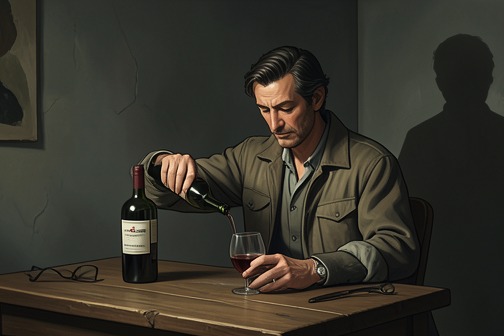
[Nathan Oliver](entity:character-recall-character-nathan-oliver-b08f2093009a)’s deliberate provision of wine to [Adrian Boyde](entity:character-recall-character-adrian-boyde-86baeb5a62d0) turned a fragile recovery into a relapse, and exposed the human cost of Oliver’s literary curiosity. The episode, recounted by [Mrs. Burbridge](entity:character-recall-character-mrs-burbridge-b369192d32ea) to [Adam Dalgliesh](entity:character-recall-character-adam-dalgliesh-461a7125784e), was not an accidental lapse or an ordinary dinner gone wrong: she believed Oliver knowingly used a recovering alcoholic as material for a novel. Its consequences extended beyond the supper, disrupting Boyde’s attempt at sobriety and leaving the island community with a lasting grievance against Oliver.
## Background and Vulnerability
Before coming to [Combe Island](entity:location-recall-location-combe-island-fad9a3251d49), Adrian Boyde had collapsed while administering Holy Communion at a church where Mrs. Burbridge’s husband had formerly been vicar. Boyde dropped the chalice and fell down drunk. After a churchwarden learned that Mrs. Burbridge had moved to the island, he wrote to the previous secretary to suggest Boyde for a job there. Boyde was capable of the work: he already knew how to use a computer and was numerate.
At first, the arrangement seemed to offer a genuine chance of recovery. Boyde remained sober on the island for more than a year, and the community hoped he could continue. The relapse therefore struck at something he had worked to achieve, rather than merely revealing a condition that had never been challenged. Mrs. Burbridge’s account stresses both the duration of his sobriety and its precariousness: the progress was real, but it could be undone by a single deliberate exposure to alcohol.
## The Supper and Oliver’s Experiment
The turning point came during one of Nathan Oliver’s quarterly visits. Oliver invited Boyde to supper and gave him wine. Mrs. Burbridge was certain that Oliver already knew Boyde was an alcoholic and had planned the encounter. In her account, the wine was not casual hospitality. Oliver was writing a book with a drunkard character and wanted to witness what would happen when an alcoholic was given wine.
The setting mattered to Mrs. Burbridge’s explanation. A drunken collapse could have been witnessed in a London club or on the streets, but that would not have given Oliver the same degree of access and control. She believed he wanted to observe someone actively trying to resist his addiction, in privacy, and to keep the situation available to him at short notice when his novel reached the relevant point. The episode thus joined artistic observation to a carefully arranged human test: Boyde’s vulnerability made him useful to Oliver precisely because his struggle was real.
After the supper, someone—Mrs. Burbridge could not say whether it was Oliver, his copy-editor, or his daughter—must have carried Boyde to his cottage. He took a couple of days to sober up. The islanders did not initially know what had happened; they knew only that he had been drinking, and assumed he might somehow have obtained wine in the house. They could not see how that explanation fitted the circumstances. Mrs. Burbridge later learned the truth from Boyde himself.
## Disappearance and Recovery
Two days after the supper, Boyde went with [Jago Tamlyn](entity:character-recall-character-jago-tamlyn-cfdf04733a3b) to collect the weekly supplies and then disappeared. Later that month, Mrs. Burbridge found him paralytic on the doorstep of her London flat. She took him in and looked after him for a few weeks before bringing him back to the island. Their life together in London proved impractical: Mrs. Burbridge recognized that the city would be impossible for them, particularly while she herself was not drinking. She found an isolated cottage near Bodmin Moor, available cheaply because the season had not started, and she and Boyde stayed there for six weeks.
This recovery was neither instantaneous nor a simple return to the earlier routine. Boyde needed care, and the move to an isolated cottage reflected the difficulty of sustaining their life together in London. It was during their time together that he told Mrs. Burbridge what Oliver had done. The island’s original uncertainty about how Boyde had obtained the wine was therefore replaced by a personal account from the person who had experienced the relapse.
## Revelation and Significance
Mrs. Burbridge’s later testimony gives the episode its moral force. She distinguished Oliver’s many lesser offenses—his bad temper, complaints about [Dan Padgett](entity:character-recall-character-dan-padgett-ce77ad7ebde1)’s inefficiency, late food deliveries, and frustration when the boat was unavailable—from what she regarded as an evil act. In her judgment, the defining wrong was not simply that Oliver disliked people or behaved rudely: he knowingly put Boyde’s recovery at risk so he could observe the consequences for his fiction.
She also insisted that Boyde might have died, and credited [Jo Staveley](entity:character-recall-character-jo-staveley-c3decdb22be8) with helping prevent that outcome. Although she said the episode had nothing to do with Oliver’s death, she was equally clear that the island would not forget it. The recollection therefore supplies a history of injury and outrage around Oliver without establishing a connection to the murder under investigation. It shows how a writer’s wish to observe suffering could cross into the deliberate creation of it, leaving the observed person—not the novel—to bear the consequences.
Event 16
SARS outbreak and isolation on Combe Island
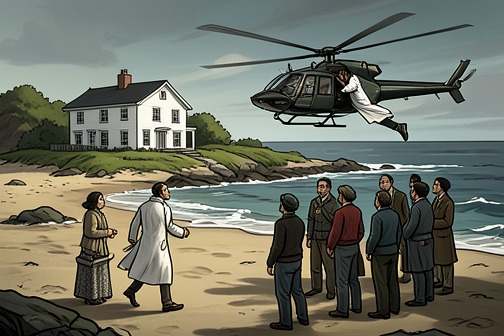
The [SARS outbreak and isolation on Combe Island](entity:event-recall-event-sars-ea8cf9e135a4) transform an already difficult murder investigation into a medical emergency. When [Dr. Speidel](entity:character-recall-character-dr-speidel-f5bd3dc26bfc) is diagnosed with SARS after being transferred to [Plymouth](entity:location-recall-location-plymouth-74fbc59efcb8), the island’s residents agree to remain under quarantine; Commander Dalgliesh then falls ill, and Inspector [Kate Miskin](entity:character-recall-character-kate-miskin-bc49acd8ef06) and Sergeant [Benton-Smith](entity:character-recall-character-benton-smith-0cc25803bfb5) must continue investigating while their senior officer is confined to a sickroom. The outbreak makes the island both a home that its residents cannot leave and a closed investigative field in which illness, uncertainty, and urgent police work converge.
## From emergency transfer to confirmed diagnosis
Dr. Speidel’s worsening condition first brings the outbreak into view as a problem of medical capacity. His temperature rises alarmingly overnight, and [Rupert Maycroft](entity:character-recall-character-rupert-maycroft-7c5479ec084a) tells Dalgliesh that Dr. [Guy Staveley](entity:character-recall-character-guy-staveley-dbfd0ffbc0c5) is arranging his transfer to a hospital in Plymouth because [Combe Island](entity:location-recall-location-combe-island-fad9a3251d49) has no facilities to nurse someone seriously ill. A helicopter is expected, and soon after landing it carries Speidel away. For the police, the evacuation removes a suspect from their immediate reach; for the island, it is the beginning of a wider emergency.
The diagnosis is confirmed after Speidel reaches hospital. Staveley tells Dalgliesh that the island will probably need to be quarantined and that he is consulting the authorities. Dalgliesh and [Jo Staveley](entity:character-recall-character-jo-staveley-c3decdb22be8) are identified as especially vulnerable because Dalgliesh helped Speidel after he collapsed and accompanied him back to his cottage, while Jo nursed him. Staveley describes the initial symptoms as resembling flu: high temperature, aching limbs, and loss of energy, with a cough that may develop later. He does not mention his own exposure during the conversation, although his role in managing the response places him close to the outbreak’s risks.
## Quarantine and the transfer of responsibility
At a meeting of the island’s residents, Kate Miskin explains that the gathering has two immediate causes: [Adrian Boyde](entity:character-recall-character-adrian-boyde-86baeb5a62d0)’s body has been found in the chapel, and Speidel has SARS. Dalgliesh is also ill, so Kate announces that she will lead the investigation with Sergeant Benton-Smith. Their work will continue on both [Nathan Oliver](entity:character-recall-character-nathan-oliver-b08f2093009a)’s death and Boyde’s murder, even as the outbreak changes the conditions under which they can investigate.
Staveley gives the residents a practical account of the danger. SARS spreads primarily through close person-to-person contact, possibly through droplets from coughing or sneezing, or through touching a contaminated surface and then transferring infected material to the nose, mouth, or eyes. He acknowledges that other airborne transmission may be possible but is not established. Those who had close contact with Speidel or Dalgliesh are at particular risk, yet he recommends that everyone on Combe Island accept voluntary quarantine for about ten days. The [Public Health Authority](entity:organization-recall-organization-829f56ce949f) has powers to impose quarantine on infected people and, in some circumstances, those at risk; Staveley argues that a voluntary island-wide restriction is the most sensible course while they await advice that it is safe to leave.
The request is also framed through the islanders’ sense of home. Staveley points out that residents are not being quarantined away from home but asked to forgo trips to the mainland until the danger has passed. No one objects at first, though [Millie](entity:character-recall-character-millie-cbf710cfdc05) briefly looks rebellious before accepting the restriction. [Daniel Padgett](entity:character-recall-character-daniel-padgett-76ad82e20c20) protests that he has an interview in London for a university course and has decided to leave Combe after his mother’s death. Missing the interview, he fears, could cost him his chance of a place. His objection exposes the personal cost of the collective measure: isolation may be medically prudent, but it interrupts individual plans at a moment of grief and change.
## Illness, care, and medical responsibility
The outbreak also places Staveley’s professional authority in a new light. At the residents’ meeting he speaks calmly and authoritatively, explaining both transmission and the reason for quarantine; later, Dalgliesh’s condition makes the physician’s guidance immediate rather than general. Dalgliesh’s last confused memories of Tuesday morning include being supported into a buggy and taken across the scrubland, then helped into bed by a masked, white-coated figure. He remembers insisting that he must stay on Combe Island, partly because he fears [Emma](entity:character-recall-character-emma-0b5c09f9ac66) will not know where he has gone and partly because an unfinished job at the lighthouse still holds him there.
By Wednesday evening Dalgliesh is clearer in mind but weaker in body. Coughing repeatedly wrenches his chest and makes breathing difficult. As the attacks worsen, Staveley and Jo Staveley attend him, insert tubes into his nostrils, and provide oxygen. Jo remains beside him in the sickroom, sometimes resting in a chair while he wakes and sleeps. The disease reduces the investigator who has been directing the case to dependence on his colleagues and carers; his authority now consists partly in communicating what must be done before his strength or speech fails.
Staveley’s conduct takes place against an older burden of medical responsibility. Jo tells him that the practice in London wants him back and that former patients are asking for him. In the same conversation, Staveley acknowledges that [Winston Collins](entity:character-recall-character-winston-collins-65207a0331e0) died of peritonitis after he failed to answer the boy’s mother’s call. He refuses to use the racial accusations surrounding that death as an excuse for his own decision, saying that he should have gone and that one should never take chances with a child. This history does not explain the outbreak, but it gives context to the seriousness with which he assumes a doctor’s obligations during it, as Combe Island’s limited medical facilities force him to make consequential decisions about transfer, exposure, and care.
## The investigation inside the quarantine
Quarantine does not suspend the murder inquiry; it makes continued investigation more urgent and more precarious. Dalgliesh becomes convinced that Kate and Benton must find a phial of blood and a lock of [Martha Padgett](entity:character-recall-character-martha-padgett-e5cf66e95993)’s hair. He knows that motive and opportunity alone do not establish the case: Padgett had reason to hate Oliver, but so did others, and more than one person could have reached the lighthouse unseen. Without the blood and hair, Dalgliesh fears, the case may never reach court.
His concern is sharpened by the possibility that Oliver’s death could be disputed in court. [Mrs. Burbridge](entity:character-recall-character-mrs-burbridge-b369192d32ea) believes Oliver may have died accidentally during an experiment, a theory consistent with the possibility that he might have undertaken such an experiment. [Edith Glenister](entity:character-recall-character-edith-glenister-29889e6d3cc2)’s post-mortem findings establish that Oliver died from asphyxiation caused by manual strangulation and that the injury to his throat could not have been self-inflicted, but Dalgliesh recognizes that the interpretation of bruising after death could be challenged by defence pathologists. Glenister has also reported that someone attempted to wipe the rope clean along its length. The combination of a disputed alternative explanation, potentially contestable forensic evidence, and missing physical evidence leaves the inquiry vulnerable even before illness sidelines its lead investigator.
Dalgliesh’s appeal to see Kate comes from the fear that his cough will return, that he may deteriorate or lose the ability to speak, and that the evidence may remain undiscovered if he cannot convey what he has understood. The outbreak therefore intersects with the case at its most fragile point: the police are confined to the island, their commander is seriously ill, and the distinction between a persuasive theory and a provable murder depends on evidence still to be found. Quarantine protects the wider community while turning time, communication, and the continuity of the investigation into urgent practical concerns.
Event 17
Combe Island SARS outbreak and quarantine
The [SARS outbreak on Combe Island](entity:state-recall-state-sars-outbreak-on-combe-64bf3c8fa780) converts an already difficult murder investigation into a crisis of isolation, medical risk, and limited resources. Once [Raimund Speidel](entity:character-recall-character-raimund-speidel-976a55c3f9a3)’s diagnosis is confirmed, the possibility of quarantine threatens to prevent reinforcements from reaching the island. The illness also strikes at the centre of the investigation: [Adam Dalgliesh](entity:character-recall-character-adam-dalgliesh-461a7125784e) has been exposed while helping Speidel, and his worsening condition leaves the case dependent on what he can communicate before he becomes too ill to do so.
## Diagnosis and the decision to quarantine
The crisis becomes explicit when [Guy Staveley](entity:character-recall-character-guy-staveley-dbfd0ffbc0c5) reports that Raimund Speidel has SARS. Staveley had suspected the illness when Speidel was transferred to [Plymouth](entity:location-recall-location-plymouth-74fbc59efcb8), but confirmation changes the situation: he is in contact with the authorities because, in his view, the sensible response is to quarantine [Combe Island](entity:location-recall-location-combe-island-fad9a3251d49). [Rupert Maycroft](entity:character-recall-character-rupert-maycroft-7c5479ec084a) and Staveley are calling residents to tell them what has happened, with a meeting planned so Staveley can explain the medical implications. Staveley warns that the diagnosis will make an already difficult situation tragic and the island’s medical circumstances harder to manage. He also identifies Dalgliesh and [Jo Staveley](entity:character-recall-character-jo-staveley-c3decdb22be8) as the people most at risk, since both helped Speidel after he collapsed.
The quarantine has immediate consequences beyond medical care. Dalgliesh’s team may not be able to bring in reinforcements, while the island’s existing residents and facilities must manage both the infection risk and the continuing investigation. The outbreak therefore restricts the very movement and outside support on which a police inquiry ordinarily depends. It does not suspend the murder case; instead, it makes its practical demands harder to meet.
## Medical care under restricted conditions
The island’s limited capacity is visible in the arrangements for removing [Adrian Boyde](entity:character-recall-character-adrian-boyde-86baeb5a62d0)’s body. When the helicopter arrives at three-thirty, masked personnel take the stretcher and exhibit bags aboard. Boyde’s hands have been covered with mittens to preserve possible evidence beneath his nails, and the body is handled with care, but the scene is organized around distance as well as forensic procedure. A table has been set about twenty yards from the helicopter so formalities can be completed without risk. The removal takes time, and the masked figures depart with both the body and the collected exhibits. The helicopter’s arrival does not mean that ordinary investigative support is readily available: [Kate Miskin](entity:character-recall-character-kate-miskin-bc49acd8ef06) and [Francis Benton-Smith](entity:character-recall-character-francis-benton-smit-367461ca9c82) later watch it leave, knowing that technical assistance may not arrive.
Care for Dalgliesh is similarly constrained. Jo Staveley reports that his temperature is higher than desired and that she has no experience nursing patients with SARS. Guy Staveley says he and Jo can cope for the moment, and he has arranged for oxygen and other equipment to be brought to the island. He nevertheless warns that if Dalgliesh’s fever remains high, the detective may have to be transferred to the mainland, since the island lacks the facilities to care for a dangerously ill man. This is not a choice between equivalent options: staying respects Dalgliesh’s wishes and keeps him near the case, while transfer may become necessary for his survival.
The outbreak draws attention to the burden Guy assumes as the island’s doctor. Earlier, he had been urged to return to his former practice because his old patients wanted him back; he had also acknowledged his remorse over failing to respond when [Winston Collins](entity:character-recall-character-winston-collins-65207a0331e0)’s mother called, insisting that a child’s illness must never be treated as a safe risk. That history gives added weight to his decision to remain at work during the outbreak. He and Jo are not simply tending a single patient: they are doing so in a place whose medical resources are inadequate for severe illness and where the doctor himself is among those most exposed.
## Dalgliesh’s illness and the unfinished case
Dalgliesh’s insistence on remaining on Combe Island persists even as his capacity to act collapses. His last confused memories of Tuesday morning are of people supporting him into the buggy, the jolting journey across scrubland, and a masked, white-coated figure helping him into bed. He remembers trying to make the people caring for him understand that he must not leave. Part of the reason is personal: he fears [Emma Lavenham](entity:character-recall-character-emma-lavenham-4de70dcf8087) will not know where he has gone if he disappears to the mainland. The other reason is the unresolved murder investigation, which he associates with the lighthouse and an unfinished task.
By Wednesday evening, his mind is clear, but his body is weaker. A severe cough repeatedly wrenches his chest and makes breathing difficult. When the coughing worsens, Guy Staveley and Jo Staveley put tubes into his nostrils and give him oxygen. Even after the worst coughing eases, fever and pain leave him too weak to manage the smallest movement easily. His isolation is therefore both physical and investigative: he is confined to bed, yet his recollection of the evidence becomes the route back into the case.
Dalgliesh’s sudden understanding of the puzzle comes while he is ill. He reconstructs it from remembered fragments of conversation, including remarks by [Mrs. Plunkett](entity:character-recall-character-mrs-plunkett-f841eb25c117), Raimund Speidel, and [Millie Tranter](entity:character-recall-character-millie-tranter-76ef6a950909). But insight alone cannot secure a prosecution. He fears that his cough may return, that his condition may deteriorate, or that he may lose the ability to speak or remember the solution. He urgently needs Kate and Benton to find the phial of blood and the lock of [Martha Padgett](entity:character-recall-character-martha-padgett-e5cf66e95993)’s hair. Without those items, he reasons, the evidence remains circumstantial: motive and opportunity are not enough, particularly when other islanders also had reason and opportunity to kill [Nathan Oliver](entity:character-recall-character-nathan-oliver-b08f2093009a).
The medical evidence carries its own legal uncertainty. Dr. Glenister has established that Oliver died from asphyxiation caused by manual strangulation, and that the neck bruising could not have been self-inflicted. Yet Dalgliesh recognizes that interpretations of post-mortem bruising could be challenged by defence experts. [Mrs. Burbridge](entity:character-recall-character-mrs-burbridge-b369192d32ea) believes Oliver may have died accidentally during an experiment, a possibility that could complicate the case in court. The outbreak thus intensifies an already urgent evidentiary problem: Dalgliesh must communicate his reasoning and the need for corroborating physical evidence while illness may soon prevent him from doing either.
## Containment and aftermath
The outbreak is ultimately contained, and the episode becomes part of the island’s later account of its recent history. Mrs. Plunkett reports that the press described Guy Staveley as clever for diagnosing SARS quickly and credits him with helping contain the outbreak. She also says that Guy and Jo are returning to their London practice, and that Guy should not continue wasting his abilities on the island. Their departure marks a change in the island’s medical arrangements as well as a consequence of the crisis: the people who managed the emergency will not remain its permanent caregivers.
The institution’s future is unsettled alongside those personal changes. Previous visitors write to ask when Combe Island will reopen, and Mrs. Plunkett expects that it will, while the island’s trustees have discussed possible new uses. Plans for important visitors to come alone will not proceed as expected. The outbreak and quarantine therefore leave more than an interval of illness behind: they interrupt the island’s usual seclusion, expose the limits of its medical provision, and make the return to its former routines a matter of deliberate reopening rather than an automatic resumption.
Event 18
The killing of Adrian Boyde by Dan Padgett
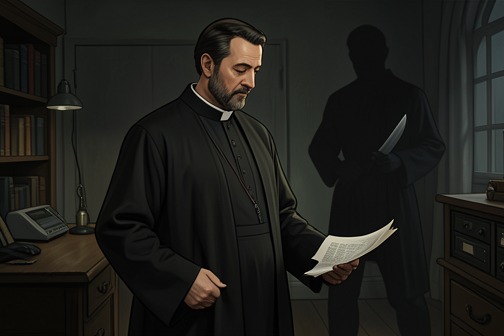
[The killing of Adrian Boyde by Dan Padgett](entity:event-recall-event-adrian-boyde-20de91f34fa6) is the second death bound up with the secret of [Dan Padgett](entity:character-recall-character-dan-padgett-ce77ad7ebde1)’s parentage. Boyde’s priestly obligation to keep a confidence left him unable to tell the police what he knew; his attempts to reach Padgett instead put him in danger. Padgett later called the attack impulsive, but the gloves he carried and the circumstances of Boyde’s final visit make that explanation difficult to accept without qualification.
## Background and the Secret
After [Nathan Oliver’s murder](entity:event-recall-event-nathan-oliver-s-murder-7fd774a9ccc5), Boyde appears to have suspected Padgett. He had heard a confidence from [Martha Padgett](entity:character-recall-character-martha-padgett-e5cf66e95993), Dan’s mother, and could not disclose it as a confessor. When Boyde found [Puffin Cottage](entity:location-recall-location-puffin-cottage-fa4f56889609) empty on Saturday morning, however, he had encountered a fact that he could have reported to the police without revealing what he had been told. He did not do so. The account raises the possibility that he instead saw his role as persuading Padgett to confess and thereby recover his soul. It also leaves open whether Boyde understood how dangerous that choice had become.
The sequence gives the killing a particular moral tension: Boyde’s silence was not simply inaction. His professional and spiritual duty constrained what he could say, while his decision to approach Padgett exposed him to the person he suspected. Dalgliesh’s later reconstruction suggests that Boyde went to Puffin Cottage on Monday night in a final attempt to reach him. The possibility that Boyde sensed he was being followed remains uncertain; the narrative frames it as a question rather than a confirmed perception.
## The Attack and Padgett’s Account
In his account, Padgett said the attack was impulsive. He claimed that he took off his jacket and picked up the stone before following Boyde into the [Combe Island Chapel](entity:location-recall-location-combe-island-chapel-5a1c4443b1da). Padgett described Boyde as kneeling, then rising to confront him; he also said Boyde neither tried to escape nor attempted to protect himself. Padgett interpreted this as a sign that Boyde wanted to die, but that is Padgett’s reading of Boyde’s conduct, not an independently established explanation.
The evidence of preparation sits uneasily beside the claim of spontaneity. Padgett had gloves, which were among the nursing equipment left in his cottage. Their presence suggests that he came prepared, even as his account casts the killing as an immediate response to events. The contrast does not, by itself, settle every detail of the confrontation, but it undermines the neatness of Padgett’s version. [Kate Miskin](entity:character-recall-character-kate-miskin-bc49acd8ef06) later recalled Boyde’s mutilated face while entering Puffin Cottage to search for evidence, a reminder that the violence had consequences beyond the competing explanations of how it began.
## Discovery and Investigation
Boyde’s death became entangled with the investigation into Oliver’s murder. Kate Miskin and Benton had to decide whom to treat as a suspect while resisting the assumption that every death on the island had necessarily been committed by the same person. Their working list for Oliver’s killing included Padgett, alongside several other people, while they debated whether to keep others under consideration. That wider inquiry did not erase the distinct question posed by Boyde’s death: what had brought Padgett and the priest together, and why had Boyde gone to him despite the risk?
The danger of the secret became more apparent as the investigators pieced together Boyde’s choices. He could not repeat a confession, but he could have reported the empty cottage; instead, he may have persisted in trying to make Padgett speak for himself. The theory that this final effort led to his being silenced connects the murder to the earlier secret without turning the inferred motive into a certainty. When [Mrs. Burbridge](entity:character-recall-character-mrs-burbridge-b369192d32ea) asked Kate whether Padgett had murdered Adrian, Kate did not answer her directly; she told those present to remain calm and follow instructions. The question marks the moment when suspicion became immediate danger for the people around her.
## Significance
Boyde’s killing reveals how a duty intended to protect private confession can become perilous when the person holding the secret tries to intervene. His silence may have preserved the confidence, but it also left the police without information that could have directed them toward Padgett sooner. The account does not settle whether Boyde knowingly risked his life or believed he could still persuade Padgett; it places those possibilities beside the concrete signs of preparation and the fatal outcome.
Padgett’s explanation that Boyde wanted to die also shifts attention away from the violence he himself committed. Against it stands the reported presence of gloves, along with the possibility that he killed Boyde to keep the secret from reaching the police. The killing thus does more than add another death to the case: it shows how Padgett’s response to exposure could turn a confidant’s attempt at persuasion into a reason to silence him.
Event 19
Benton discovers a suspected murder weapon below the sea cliffs
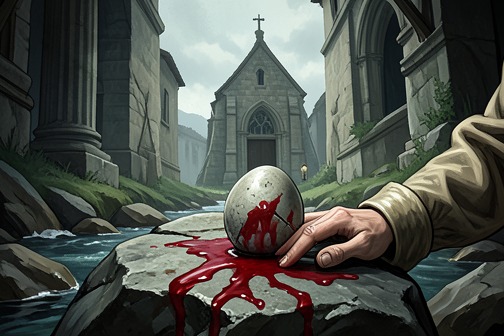
[Francis Benton-Smith](entity:character-recall-character-francis-benton-smit-367461ca9c82)’s discovery below the sea cliffs turns a difficult search into a promising forensic lead: on a narrow shore beneath the chapel, he finds an egg-shaped stone caught in a remnant of surgical glove, with a reddish stain that appears to be blood. The object may be connected to [Nathan Oliver](entity:character-recall-character-nathan-oliver-b08f2093009a)’s killing, but it is recovered as a suspected weapon, not yet proven to be one. Its significance rests both on what it looks like and on the careful, limited claims the investigators can make about it.
## Background and the Search
The search takes place against the developing forensic picture of Oliver’s death. [Edith Glenister](entity:character-recall-character-edith-glenister-29889e6d3cc2)’s initial examination placed the time of death between 7:30 and 9:00 in the morning, probably nearer the earlier time. She identified finger-shaped bruises on the neck and concluded that Oliver had been strangled before his body was hanged. Her later autopsy report confirmed death by asphyxiation from manual strangulation and described a fracture of the thyroid cartilage and a bruise at the back of the neck, where his head had been forced against something hard. Those findings give the search for a possible blunt instrument a specific investigative context, but they do not by themselves identify any particular stone as the weapon.
Another strand of the inquiry concerned the climbing rope used in the staged hanging. [Jago Tamlyn](entity:character-recall-character-jago-tamlyn-cfdf04733a3b) had been told to rewind it and return it to its hook after the stretcher was taken away; the lighthouse door was unlocked, so others could have reached the rope. [Kate Miskin](entity:character-recall-character-kate-miskin-bc49acd8ef06) later secured it in an exhibit bag with Francis Benton-Smith adding his name, but laboratory examination found that someone had tried to wipe it along its length. The rope’s handling and cleaning complicate that line of evidence. The search beneath the cliffs is separate: it seeks a small, heavy stone that might retain a trace of blood.
Kate Miskin, Francis Benton-Smith, and Jago Tamlyn travel by buggy toward the chapel. Kate stops about twenty yards away to preserve the ground near the scene, then leads the group down through bushes and jutting rocks to a narrow lower ledge. They follow it until they are beneath the chapel and look down over an approximately eighty-foot drop. Below lies a cove without a beach, crowded with stones and boulders; the tide is coming in quickly. The place makes the search urgent as well as physically difficult: each advancing wave reduces the exposed ground available to examine.
## The Descent and Search
Kate judges that either she or Francis Benton-Smith must abseil down, and asks [Jago](entity:character-recall-character-jago-e24638098dea) for help. Benton goes down. As Jago secures the slings around a boulder and Benton clips in, the familiar preparations bring back Benton’s memories of climbing, including the ritual silence in which he and his grandfather used to prepare. He has not experienced this kind of descent for more than a decade. At the edge, he leans backward into space; the rope holds, and the initial fear gives way to the renewed exhilaration of controlling his descent with his hands and the karabiner.
Once at the bottom, Benton releases himself, puts on search gloves, and assesses the strip of sea-smoothed rocks. He is looking for a stone heavy enough to serve as a weapon but small enough to be held in the hand, ideally with blood still on it. The rocks are piled in their thousands, many polished by the sea and similar in size and weight to what he seeks. Meanwhile, the incoming tide covers the outermost rocks and advances into the pools. Benton searches yard by careful yard, knowing that the visible ground is disappearing and that he will still have to climb back up. The scene’s brief exhilaration has become a race against the water and the dwindling chance of finding anything.
## Discovery and Recovery
Near the cliff’s edge, Benton notices a pale scrap of litter on the otherwise untrodden shore. It is an egg-shaped stone, partly enclosed in what appears to be the remnant of a surgical glove. Most of the thin latex has torn away, but one finger and part of the palm remain. On the stone is a reddish stain that Benton believes can only be blood. The glove fragment and stain make the stone more than an object of the right size: they are visible traces that may connect it to an act of violence, though the discovery alone cannot establish whose blood it is or how the marks came to be there.
Benton puts the stone into an exhibit bag, closes it, and ties the package to the abseil rope. He calls up that he has found it, and Kate signals from above as the bag is hauled to the cliff top. The recovery is immediate and practical rather than a completed forensic conclusion: the package is brought out of the incoming tide and preserved for further examination. Jago then descends, and the group prepares to move around the outcrop toward the next climb. The rock remains a suspected murder weapon whose material traces need testing.
## Evidentiary Significance
The find gives the investigation a concrete object to examine, but the details of its discovery matter as much as its apparent promise. The stone is found on a shore where seawater is actively washing over the rocks; the glove material is torn, and only a small portion remains. The reddish mark looks like blood to Benton, but the scene supplies no laboratory identification, no confirmed source for the stain, and no proof that the stone caused Oliver’s injuries. Its recovery in an exhibit bag preserves it for examination without resolving those questions in advance.
The episode also brings together the novel’s competing forms of evidence: medical findings that establish strangulation, a rope whose condition has been compromised by wiping, and a newly recovered object bearing possible traces of blood and a glove. None should be treated as interchangeable or conclusive on its own. The discovery matters because it opens a testable line of inquiry and because Benton, under pressure from the tide and the difficult terrain, finds the particular object the team was seeking. The success is real, but its meaning remains provisional until the evidence can be assessed.
Event 20
Dalgliesh solves the case while ill
[Dalgliesh solves the case while ill](entity:event-recall-event-dalgliesh-1eade2a0a70d) through a sudden reordering of evidence that shifts the investigation from asking who arrived on [Combe Island](entity:location-recall-location-combe-island-fad9a3251d49) to asking who had left. Fever-bound and afraid that he might lose the power to speak, he sees how [Martha Padgett](entity:character-recall-character-martha-padgett-e5cf66e95993)’s secret, the apparently lost blood sample, and [Dan Padgett](entity:character-recall-character-dan-padgett-ce77ad7ebde1)’s movements connect to [Nathan Oliver’s murder](entity:event-recall-event-nathan-oliver-s-murder-7fd774a9ccc5). His insight supplies a motive and directs [Kate Miskin](entity:character-recall-character-kate-miskin-bc49acd8ef06) and [Francis Benton-Smith](entity:character-recall-character-francis-benton-smit-367461ca9c82) toward physical evidence needed to support it in court.
## Illness and the return of the clues
On Tuesday, Dalgliesh’s last fragmented memories were of being carried into a buggy and taken across the island beneath a suddenly scorching sky, then helped into bed by a masked, white-coated figure. Though confused, he kept insisting that he must remain on Combe Island: [Emma Lavenham](entity:character-recall-character-emma-lavenham-4de70dcf8087) would need to know where he was, and an unfinished matter at the lighthouse also held him there. By Wednesday evening his thoughts had cleared, but his body had weakened. A wrenching cough shortened his breath; as his attacks worsened, [Guy Staveley](entity:character-recall-character-guy-staveley-dbfd0ffbc0c5) and [Jo Staveley](entity:character-recall-character-jo-staveley-c3decdb22be8) placed tubes in his nostrils and gave him oxygen. Jo remained beside him while he rested in the dim sickroom.
The solution came not as a triumphant flash but as separate remembered details clicking together. Dalgliesh recalled [Mrs. Plunkett](entity:character-recall-character-mrs-plunkett-f841eb25c117)’s account of someone being frightened in a cabin, [Raimund Speidel](entity:character-recall-character-raimund-speidel-976a55c3f9a3)’s precise recollection that Oliver had publicly disclosed his regular visits to Combe in an April 2003 newspaper article, and [Millie Tranter](entity:character-recall-character-millie-tranter-76ef6a950909)’s explanation for why she had not delivered Speidel’s note promptly: the proposed meeting was not until eight the next morning. [Millie](entity:character-recall-character-millie-cbf710cfdc05) had admitted reading the note because it was open. Dalgliesh also remembered Dan Padgett seeing smoke from a chimney, [Adrian Boyde](entity:character-recall-character-adrian-boyde-86baeb5a62d0)’s claim that he had seen nobody on his walk, and Oliver’s lone paperback among the popular romantic novels at [Puffin Cottage](entity:location-recall-location-puffin-cottage-fa4f56889609). Each memory had seemed incidental; together, they challenged the investigation’s assumptions.
## Reversing the investigation
The team had concentrated on who had come to the island since Oliver’s previous visit, treating a newcomer’s arrival as a possible trigger for murder. Dalgliesh recognized that the more revealing question was who had gone. Martha Padgett, a dying woman carried away from Combe Island in her coffin, had been left out of that account. Her death and the incident in which Dan appeared to lose Oliver’s blood sample were not peripheral events: Dalgliesh saw them as the center of the case.
He reconsidered Dan’s account of the sample going overboard. The apparent loss, he concluded, had been staged: what Dan had let fall into the sea was old shoes, handbags, and library books; the blood sample had never been in the bag. He also reinterpreted the smoke Dan had seen shortly before eight. Dan had seen it from the lighthouse platform, Dalgliesh reasoned, rather than from his cottage window. That placed him at the lighthouse and altered the significance of Adrian Boyde’s report that he had encountered no one on the headland: Boyde had gone to Puffin Cottage to speak with Dan, but Dan was absent.
## Martha’s secret and the motive
Dalgliesh connected the murder to a confidence Martha had made before her death. She had told Adrian Boyde, who had cared for her and served as her confessor, that Dan was [Nathan Oliver](entity:character-recall-character-nathan-oliver-b08f2093009a)’s son. Bound by the seal of the confessional, Boyde could not disclose what Martha had told him. Dalgliesh inferred that Boyde must have urged her to tell Dan herself, rather than reveal the secret on her behalf.
Martha and Dan had arrived on Combe Island in June 2003, after Oliver’s April newspaper interview had made his regular visits public and broken the Trust’s confidentiality agreement. Dalgliesh considered whether Martha hoped that father and son might meet and that Oliver might acknowledge Dan. He also weighed why Martha had kept silent for so long: Oliver was famous and difficult to hide, but at the time of Dan’s birth DNA testing was not available. Her death may have made the long-postponed disclosure urgent. Oliver’s paperback in Puffin Cottage suggested to Dalgliesh that Martha had kept and reread at least one of his books, though what it meant about their past remained conjectural.
The hair evidence gave Dalgliesh another link between Dan and the concealed parentage. Mrs. Plunkett had described him pulling hair out. Dalgliesh reasoned that he had not cut it because he knew DNA testing required the roots. That knowledge, alongside the blood sample, could provide evidence of a biological connection. He also saw how Dan’s deprived childhood and humiliation might have sharpened resentment toward a mother who had kept the truth from him, although the precise balance of anger, hope, and financial expectation in Dan’s actions remained an inference.
## From reconstruction to evidence
Dalgliesh’s reasoning placed Dan’s confrontation with Oliver on the morning of the murder. He considered that Dan might have seen Oliver walking toward the lighthouse, taken the secluded lower-cliff route to meet him, and intended to disclose his parentage and demand acknowledgment or financial provision. The encounter, on this reconstruction, became a quarrel, a fatal grip at Oliver’s neck, and an attempt to disguise homicide as suicide. Earlier medical findings supported murder rather than hanging: [Edith Glenister](entity:character-recall-character-edith-glenister-29889e6d3cc2) assessed the time of death as between seven-thirty and nine, probably nearer the earlier time, and identified strangulation before the body was hanged. Her later autopsy account described extensive internal damage and a fracture consistent with pressure to the neck. Those findings established the manner of death, but did not alone identify the killer.
Dalgliesh understood that his reconstruction was still vulnerable. Others on the island had reasons to hate Oliver and could have reached the lighthouse unseen. [Mrs. Burbridge](entity:character-recall-character-mrs-burbridge-b369192d32ea)’s belief that Oliver might have died accidentally during an experiment also gave the defence a possible alternative to murder; disputed interpretations of bruising could complicate a case based chiefly on circumstances. Although the rope had been wiped along its length, that fact did not resolve identity. At five in the morning, fearing that his cough might return or that he might lose the ability to communicate, Dalgliesh insisted on seeing Kate. He told her and Benton that they had to find the blood phial and Martha’s lock of hair: motive and opportunity were not enough without evidence that could withstand a trial.
Kate and Benton found the items concealed beneath butter in a tub at Puffin Cottage. After photographing the container, Kate uncovered two foil-wrapped packages: one held the phial labelled with Oliver’s name and date; the other held hair wrapped in tissue paper. The handwritten label could identify the blood sample even though Dan had apparently discarded the laboratory paperwork. Benton and Kate photographed the evidence, sealed the phial and hair in an exhibit bag, and signed its label. The discovery did not make Dalgliesh’s deductions identical to proof, but it gave the investigators the material evidence his bedside reasoning had recognized as essential.
## Significance
The solution turns on a change of investigative direction rather than a wholly new clue. Details already heard—the delayed note, the newspaper disclosure, the smoke, the missing man at Puffin Cottage, and the supposedly lost sample—acquire different meanings when the investigators account for Martha’s departure and the secret she carried. Illness makes Dalgliesh physically dependent and uncertain whether he will be able to speak, yet the quiet interval between coughing attacks becomes the setting in which he reconstructs the case. His urgent call to Kate marks the limit of deduction: he can identify how the clues fit, but the case still needs evidence beyond his interpretation. The hidden phial and hair answer that practical need, linking the family secret that supplies the motive to the investigation’s demand for something testable.
Event 21
Dan Padgett murders Nathan Oliver
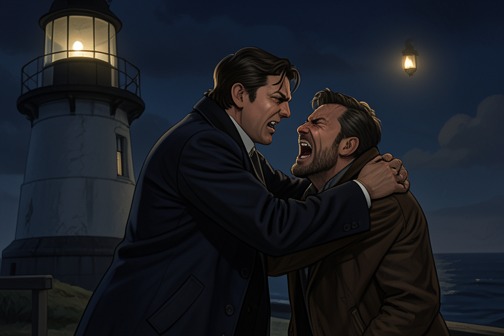
[Dan Padgett murders Nathan Oliver](entity:event-recall-event-dan-padgett-nathan-oliv-c5751f2e0a9e) after discovering that Oliver is his father and confronting him at the lighthouse. The killing joins a concealed family history to a sudden, devastating refusal: Padgett seeks acknowledgment and financial provision, Oliver rejects both, and Padgett strangles him before trying to make the death look like suicide.
## Background and Motive
Before her death, [Martha Padgett](entity:character-recall-character-martha-padgett-e5cf66e95993) confided to [Adrian Boyde](entity:character-recall-character-adrian-boyde-86baeb5a62d0) that Dan was [Nathan Oliver](entity:character-recall-character-nathan-oliver-b08f2093009a)’s son. She had entrusted the secret to Boyde, who had ministered to her and whom she and [Mrs. Burbridge](entity:character-recall-character-mrs-burbridge-b369192d32ea) regarded as a priest; he was therefore bound by the seal of the confessional. Dalgliesh reasons that Boyde could not disclose what he had heard, but may have urged Martha to tell Dan herself. The secret’s revelation gives Padgett’s hatred of Oliver a new and intimate basis: the man he resented was not merely a famous island visitor, but his father.
Martha and Dan arrived on [Combe Island](entity:location-recall-location-combe-island-fad9a3251d49) in June 2003, after Oliver had publicly said in an April interview that he regularly visited the island. The interview broke the Trust’s agreement to keep information about Combe Island confidential and may have made a meeting between father and son possible. Dalgliesh considers whether Martha hoped that they would meet and that Oliver might acknowledge Dan. He also notes that DNA testing had not been available when Dan was born, while its later existence—and Martha’s awareness that she was dying—may have changed how she understood the possibility of proving his parentage. These circumstances help explain why the secret came to matter urgently, although Martha’s exact hopes and reasons for waiting remain conjectural.
## The Confrontation and Killing
Dalgliesh reconstructs the killing as an impulsive confrontation rather than a planned murder. Evidence about Padgett obtaining hair leads him to infer that Padgett knew DNA testing required roots. The force with which the hair was pulled out, recalled by [Mrs. Plunkett](entity:character-recall-character-mrs-plunkett-f841eb25c117), suggests determination to obtain proof, while also fitting Dalgliesh’s account of a man carrying years of anger and humiliation. Padgett’s confidence about a different future may have reflected a hope that proof of his parentage would compel Oliver to acknowledge him and provide for him.
Padgett later described the confrontation to [Kate Miskin](entity:character-recall-character-kate-miskin-bc49acd8ef06). Oliver went up to the lighthouse lantern, and Padgett followed him there and told him his story. Oliver answered that he might have supported Padgett as a child but owed him nothing as a man, adding, “I owe you nothing and you’ll get nothing.” He dismissed Padgett as a contemptible blackmailer. Padgett then flew at him and fastened his hand around Oliver’s throat. The account supplies the immediate trigger: the hoped-for recognition was met not with uncertainty or negotiation but with rejection and contempt.
## The Attempted Disguise and Its Significance
After strangling Oliver, Padgett tried to make the killing appear to be suicide. Dalgliesh’s reconstruction connects that failed disguise to the abruptness of the attack: Padgett may have seized what he saw as an opportunity to confront Oliver, then made a hapless attempt to conceal the violence once the confrontation ended in death. The murder thus combines accumulated grievance with a sudden act; the evidence supports neither a long-prepared plan nor a simple, motive-free outburst.
The killing also brings together the consequences of several silences. Martha had withheld Dan’s parentage for years; Boyde’s religious obligation prevented him from exposing her confidence; and Oliver’s public disclosure of his visits helped make a meeting possible. At the lighthouse, the truth finally reaches Oliver, but the acknowledgment Padgett seeks is refused. That refusal turns the discovery of kinship into the immediate cause of a second violent death, while the attempted staging cannot erase the confrontation that produced it.
Event 22
Search of Puffin Cottage uncovers blood and hair samples
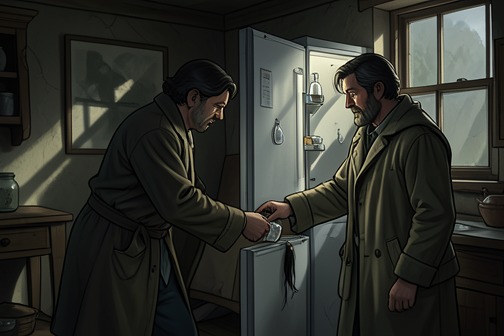
The search of [Puffin Cottage](entity:location-recall-location-puffin-cottage-fa4f56889609) is the point at which a painstaking murder investigation yields concealed physical evidence: beneath butter in [Dan Padgett](entity:character-recall-character-dan-padgett-ce77ad7ebde1)’s refrigerator, [Kate Miskin](entity:character-recall-character-kate-miskin-bc49acd8ef06) and [Francis Benton-Smith](entity:character-recall-character-francis-benton-smit-367461ca9c82) find [Nathan Oliver](entity:character-recall-character-nathan-oliver-b08f2093009a)’s labelled blood sample and a separate hair sample. The discovery connects Padgett’s cottage to evidence that had been missing from the investigation, while birth certificates hidden elsewhere in the cottage expose a secret about his family. The search’s quiet, methodical progress ends abruptly when someone appears at the kitchen window and blocks the door, converting a successful search into a dangerous encounter.
## Timing and Stakes
Kate and Benton delay entering Puffin Cottage until the time is right. Searching before daylight, while the other cottages are dark, would make their light conspicuous and risk drawing attention. More importantly, if the evidence is still inside, Padgett might remove or destroy it as soon as he realizes a search is under way. The investigators therefore move quickly and quietly, crossing the headland from Kate’s apartment and using the clearly labelled keys [Rupert Maycroft](entity:character-recall-character-rupert-maycroft-7c5479ec084a) had given them. Kate locks the cottage behind them, preserving the secrecy of their entry.
The search also carries an emotional charge that Kate recognizes. She has long disliked the invasion of a victim’s private space, with its intimate and often pathetic remains, and usually feels an irrational guilt while searching. This time, remembering [Adrian Boyde](entity:character-recall-character-adrian-boyde-86baeb5a62d0)’s mutilated face, her unease gives way to anger and hope. That change does not make her less careful: when the search produces evidence, she insists on photographs and controlled handling rather than allowing triumph to interrupt procedure.
## The Cottage and the First Concealment
The cottage’s familiar, dispiriting order has been disturbed. In the growing light, Kate sees that the ornaments have been cleared from the mantelpiece, the bookcase is empty, and two cardboard boxes stand nearby. These changes suggest that Padgett has begun clearing the room, sharpening the urgency of finding anything he might otherwise carry away. The sitting room remains gloomy behind its drawn curtains, as if still in mourning, but the newly emptied surfaces show that its contents are no longer settled in place.
Benton explains that he borrowed one of Nathan Oliver’s novels from the library and read it through the night. He describes a scene in which a sixteen-year-old girl is raped on a school trip, noting the novel’s simultaneous treatment of the man’s and the girl’s perspectives. Kate declines to pursue the literary discussion and directs attention to the bread oven in the fireplace. Its iron door is shut and its interior dark; Benton uses a torch from Kate’s murder case while she asks him to test whether any bricks are loose.
Working at the grouting with his penknife, Benton dislodges a brick and finds a cavity. Inside is an envelope containing two birth certificates: one for [Martha Padgett](entity:character-recall-character-martha-padgett-e5cf66e95993), born on 6 June 1962, and one for Dan Padgett, born on 9 March 1978. The space for the father’s name on Dan’s certificate is blank. The documents make the concealed family question concrete without answering it on their own. Their hiding place, behind a removable brick in the oven, shows that Padgett treated them as evidence he needed to keep out of sight.
## Evidence Hidden in the Refrigerator
The search continues into the small kitchen, where clean surfaces and a tidy floor suggest a room that may have gone unused for weeks. The refrigerator complicates that impression: it contains butter, milk, and half a loaf of wholemeal bread. Kate checks the eight remaining slices individually and finds nothing pressed between them. She then examines the butter. At her request, Benton finds a meat skewer, and she tests the tub carefully; it enters less than half an inch before meeting something concealed inside.
From this moment the pair document their actions. Kate asks for photographs of the refrigerator and the tub, then removes the surface layer of butter. A sheet of foil lies beneath it, covering two small foil-wrapped packages. One contains a phial of blood whose label still bears Nathan Oliver’s name and the date; the other contains a hair sample wrapped in tissue paper. Benton observes that the handwritten name and date should allow the blood to be identified, even though Padgett has not kept the paperwork describing the tests [Guy Staveley](entity:character-recall-character-guy-staveley-dbfd0ffbc0c5) wanted performed.
The location and packaging make the find more than a casual discovery of stored material. The samples are concealed beneath food in a refrigerator whose contents otherwise seem inconsistent with the kitchen’s apparent disuse. Kate and Benton photograph the items, including the refrigerator and the rubbish bin, place the phial, hair, and butter tub together in an exhibit bag, and seal it. Both sign the label, creating a documented record of the evidence they have recovered.
## The Search Becomes a Confrontation
The bin adds a further, striking detail to the search. Among its contents are broken china figurines and torn pages; the head of a figurine lies on the pages. Benton identifies the remains as the wreckage of his mother’s keepsakes and a paperback by Oliver, linking two kinds of destruction in Padgett’s cottage. The objects do not by themselves explain his actions, but their presence makes the cottage’s disorder more revealing than its otherwise clean surfaces.
As Benton finishes photographing the evidence, Kate and he notice a fleeting face at the kitchen window. They cannot be certain what first alerted them; they register two frightened eyes and a shorn head before the figure disappears. They hurry to the door, but the delay in finding the right key costs them several seconds. When Kate tries to insert it, the lock will not accept it: the person outside has blocked the door with his own key.
The search therefore ends on a double reversal. Inside the cottage, the hidden samples turn suspicion into material evidence and the certificates expose a family secret; outside, the person who has apparently discovered the search prevents the investigators from leaving normally. The episode’s suspense arises from the contrast between painstakingly controlled evidence handling and the sudden loss of control at the exit. The recovered items are secured, but their discovery has also made the investigation’s danger immediate.
Event 23
Lighthouse hostage crisis and Dan Padgett’s arrest
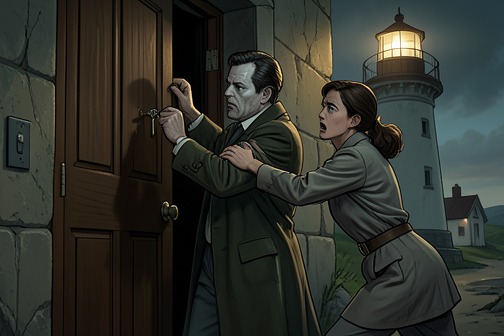
The [Lighthouse hostage crisis and Dan Padgett’s arrest](entity:event-recall-event-dan-padgett-19a59a6822f2) turn the discovery of evidence into an immediate struggle over [Millie Tranter](entity:character-recall-character-millie-tranter-76ef6a950909)’s life. When Padgett escapes the house and takes [Millie](entity:character-recall-character-millie-cbf710cfdc05) onto the narrow outer ledge of [Combe Island lighthouse](entity:location-recall-location-combe-island-lightho-69d40764ccc8), [Kate Miskin](entity:character-recall-character-kate-miskin-bc49acd8ef06) and [Francis Benton-Smith](entity:character-recall-character-francis-benton-smit-367461ca9c82) have to pursue him without knowing whether they can reach her in time. Miskin’s painful entry through a barred window and [Benton-Smith](entity:character-recall-character-benton-smith-0cc25803bfb5)’s eventual approach across the gallery end the standoff with Millie rescued and Padgett under arrest.
## From the search to the pursuit
Miskin and Benton-Smith have just finished securing the search’s finds: a phial, hair, and a butter tub, photographed and sealed together in an exhibit bag. The handwritten name and date on the label promise clear identification, even though the paper that would have detailed the tests was not there. Their satisfaction at the result is brief. A fleeting face at the kitchen window catches their attention: two terrified eyes beneath a shorn head, gone before either officer can be sure what alerted them.
They rush to the door, but Padgett has blocked it from outside with his own key. Miskin loses three seconds finding the right key on her bunch; the delay is enough to force another way out. The first window will not move. Benton-Smith tries a second, then smashes its frame with a chair. Miskin sends him after Padgett, judging him the faster pursuer, while she stays to protect the exhibits and camera. He has already gone through the broken window when she follows with the murder case and camera.
Padgett is running towards the sea, with Benton-Smith closing behind him. The delay gives him a lead, and he might have disappeared from sight had [Jago Tamlyn](entity:character-recall-character-jago-tamlyn-cfdf04733a3b) not come round the corner of the house and collided with him. Both men fall; Padgett gets up first and resumes his flight. He and Benton-Smith race towards the lighthouse. Miskin sees Millie Tranter coming round its edge, standing still in astonishment as the two men approach. Padgett scoops her up, carries her through the lighthouse door, and bolts it before the pursuers arrive.
## The threat on the gallery
The hostage-taking changes the chase into a public emergency. Padgett brings Millie up to the gallery and holds her outside its rail, on a ledge only six inches wide. She clutches the rail and screams while he grips her arm and edges her towards the seaward curve. The group below can see her precarious position but cannot hear what Padgett is shouting over the breeze. Benton-Smith reports that the evidence is secure in the safe and that Tamlyn is fetching ladders; one of the longer ladders will need two people to handle it.
The first attempt to find an opening shows how little the lighthouse’s structure will yield. The upper windows are narrow slits, while the lower one nearest the door is about twelve feet from the ground, roughly three feet high and eighteen inches wide. Its iron bars are embedded too deeply in the stone to be broken free. Miskin decides to squeeze through a segment of the window instead. She strips down to her underwear, bra, socks, and shoes, and smears Vaseline over her body to make the passage possible. Benton-Smith helps her, while [Guy Staveley](entity:character-recall-character-guy-staveley-dbfd0ffbc0c5) watches in silence.
Miskin has to enter feet-first, using the lower bars for a hold. Her hips and torso pass, but her shoulders become stuck. Benton-Smith pushes when she orders him to, and the pressure dislocates her shoulder. She continues directing him to push until she gets through. Inside, she catches a bar with her good arm, drops to the floor, and makes her way down the steps to unbolt the door. Her left arm is useless and the pain is severe, but opening the way allows Benton-Smith and Staveley to enter.
## Rescue and arrest
After reaching the gallery, Miskin pauses, dazzled by the daylight and the view of sea, sky, and island. There is no sound to tell her whether Millie is alive. She proceeds with Benton-Smith, who is beside her as they move around the gallery. Padgett is holding Millie with one hand and the top rail with the other. Miskin reads fear and hatred in his face, alongside a determination that makes each word and movement consequential.
Miskin addresses Padgett calmly and asks him to listen, telling him that killing Millie will not help him and that he will regret it. Millie moans and cries while Padgett answers with a stream of obscenities. Benton-Smith offers to try speaking to him instead. He moves closer along the rail, reaches Millie’s arm, and talks to Padgett at close range. Miskin cannot hear his words. Padgett does not interrupt. After the exchange, Benton-Smith lifts Millie back over the rail with both arms, and Miskin catches her with her one good arm as the girl sobs.
Padgett remains on the gallery. Miskin stands and formally arrests him. The immediate danger has passed, but the rescue does not erase its cost: she has forced herself through a barred window at the expense of a dislocated shoulder, while Millie has been held on a ledge above the island. Benton-Smith’s conversation, by contrast, reaches Padgett without another physical confrontation and makes it possible to bring Millie safely across the rail.
## Custody during the quarantine
Padgett is placed in Benton-Smith’s apartment under Benton-Smith’s guard, manacled and sitting on an upright chair with his hands between his knees. He stares into space, showing emotion only when Miskin enters, when he directs contempt and disgust at her. Miskin contacts London and the [Devon and Cornwall Constabulary](entity:organization-recall-organization-devon-and-cornwa-14e9c78e400a) to arrange his transfer. The island’s SARS quarantine complicates that decision: officials must weigh the risks and legal procedures, although Miskin considers the risk of removing Padgett small because neither she nor Benton-Smith is showing symptoms. The authorities agree that he cannot remain on the island; the crisis therefore ends with his arrest but with transfer still being arranged.
Event 24
Dalgliesh reunites with Emma and they decide to marry

The reunion of [Adam Dalgliesh](entity:character-recall-character-adam-dalgliesh-461a7125784e) and [Emma Lavenham](entity:character-recall-character-emma-lavenham-4de70dcf8087) at the end of their stay on [Combe Island](entity:location-recall-location-combe-island-fad9a3251d49) reverses the rejection he has come to expect from love. After two weeks of sparse communication, Dalgliesh approaches their meeting braced for a dignified ending; [Emma](entity:character-recall-character-emma-0b5c09f9ac66) arrives by helicopter and instead makes their future together explicit, proposing that they arrange to marry. His answer is not another solitary proposal but a plan for them to visit Father Martin together the next day.
## Departure and apprehension
The reunion takes place on the day Dalgliesh and his companions are at last able to leave Combe Island. Although ready early, he waits at [Seal Cottage](entity:location-recall-location-seal-cottage-fd5d3c67ba74) until the helicopter comes into view. Before leaving, he places the cottage key on the table, where it seems to promise a return, even though he believes he will never see Combe again. The small gesture holds together attachment and departure: the island has mattered to him, but leaving it also means going to meet Emma and learn what their relationship can become.
His walk across the scrubland toward the house is accompanied by longing, hope, and dread. He and Emma have spoken only rarely during the previous two weeks, and he has lost faith in the telephone as a way of managing important truths. The passage presents a particular difficulty for a man who loves language: words exchanged at a distance can be reconsidered and doubted, while he longs for the certainty of a face-to-face answer. He has already written to propose marriage, not an extended engagement, and believes he has received a response. To ask again risks making him seem like a petulant child; to have pressed the matter while ill might have seemed like an appeal for pity.
Dalgliesh’s anxiety is sharpened by the possibility that [Clara Beckwith](entity:character-recall-character-clara-beckwith-e253241a0990) dislikes him and may have voiced doubts Emma herself only partly acknowledges. More painfully, his memory supplies earlier women’s explanations for ending relationships: they refer to separate cities, his demanding work, his poetry, and his supposed inability to commit. He expects Emma to say that she loves him, but cannot assume that love will lead to marriage. The contrast between the certainty he hopes to hear and the endings he remembers explains why he prepares to accept the destruction of hope without complaint.
## The meeting
The helicopter appears to hover for a long time before landing precisely in the middle of the marked cross. Dalgliesh must wait again while its blades stop spinning; only then does the door open and Emma emerge. She takes a few tentative steps, then runs into his arms. The movement overturns the scene he has anticipated: she does not approach to deliver a careful refusal but crosses the remaining distance to him.
Dalgliesh feels her heart beating and hears her whisper, “I love you, I love you, I love you.” Her tears are warm against his cheek. The repeated words answer the fear that their recent silence has concealed a withdrawal, but the decisive change arrives when she looks up and speaks firmly. Her proposal is practical as well as intimate: if they want Father Martin to marry them, and Dalgliesh is happy with that, they should set a date quickly, before he decides he is too old to travel. Emma does not leave their future at the level of reassurance; she names a next step and asks whether she or Dalgliesh should write to him.
## A shared decision
Dalgliesh answers, “Neither. We’ll go to see him together. Tomorrow.” His reply converts the reunion into a joint commitment. The immediate plan is specific—a visit to Father Martin the following day—rather than a vague promise to settle the question later. In the scene’s emotional sequence, Emma’s declaration relieves his fear, her proposal makes marriage a mutual intention, and his answer gives that intention a shared action.
As Emma follows him toward the door, Dalgliesh pauses in silence for a final look at the room and recognizes that he has been happy there. The ending thus joins two departures: the closing of his time on Combe Island and the movement toward a life he will undertake with Emma. The key left on the table had seemed to promise a return that he does not expect to make; the promise that matters instead is the one made face to face.
## Narrative significance
The scene resolves the uncertainty created by distance without pretending that distance has been harmless. Dalgliesh’s memories of former breakups and his doubts about asking again remain part of the moment; they make Emma’s direct approach and practical proposal the answer to a real fear, not merely a formality. The reunion also changes the terms of his earlier proposal. Rather than repeating it alone and waiting for judgment, he accepts a future in which Emma and he will take the next step together.
The conclusion is witnessed from outside the couple’s embrace. Waiting at the rear entrance, [Kate Miskin](entity:character-recall-character-kate-miskin-bc49acd8ef06) hears Dalgliesh’s exultant laugh ring over the headland. The sound makes his relief audible to another member of the departing party, while leaving the intimate exchange itself between Emma and Dalgliesh. Their decision is not a completed wedding: it is a definite intention, attached to a date for action and a visit to Father Martin. That distinction gives the ending its promise without claiming that the marriage has already taken place.